
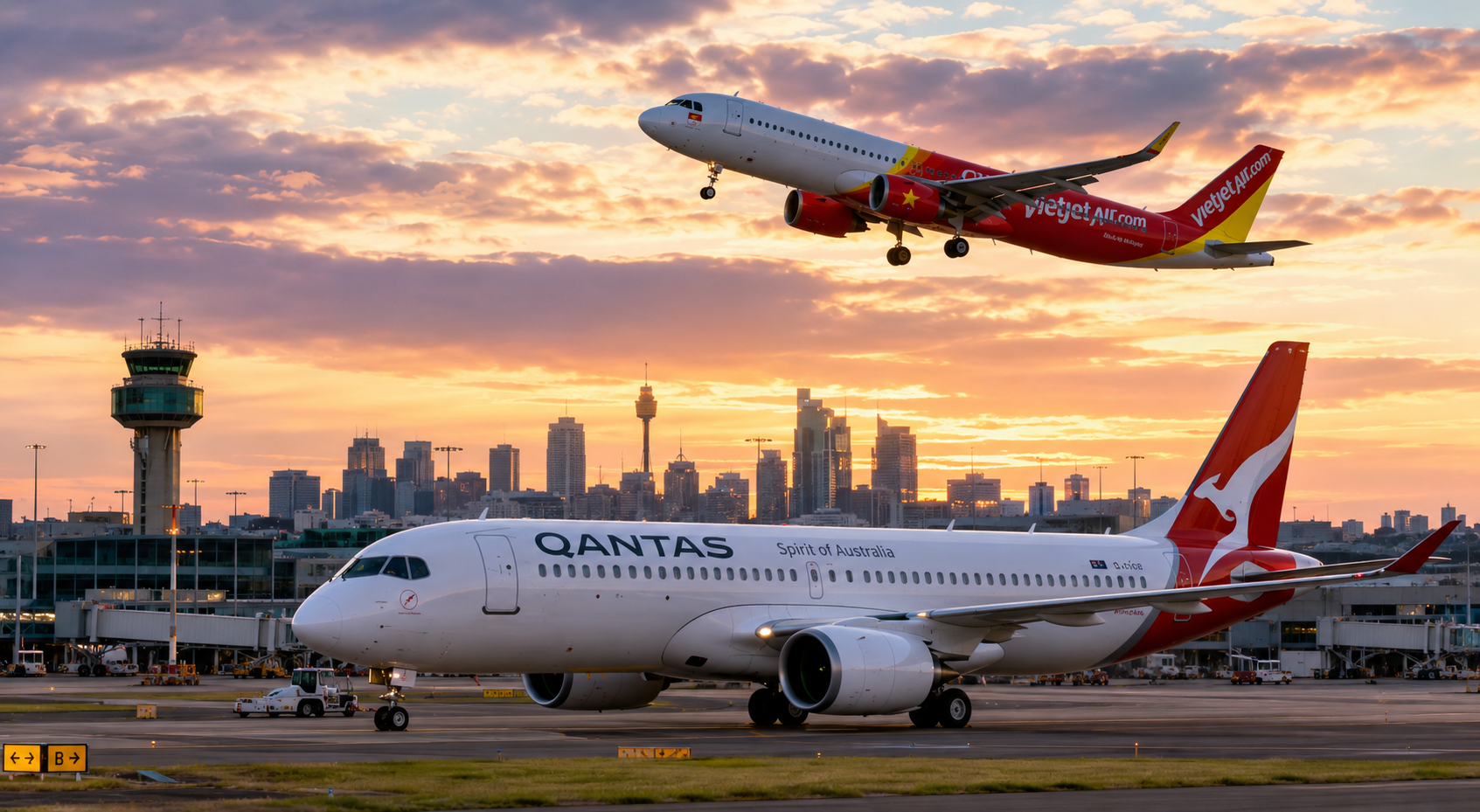
Australia’s airline industry could be approaching another turning point. Vietnamese low-cost carrier VietJet is reportedly studying plans to establish an Australian-based airline, a move that would give the country its first serious new domestic competitor since Bonza collapsed in 2024. While the proposal is still in its infancy and faces a long list of regulatory and commercial hurdles, it has already reignited debate about competition in one of the world’s most concentrated aviation markets.
The timing is particularly interesting because it comes as Qantas is heading in the opposite direction. Australia’s largest airline has confirmed it will withdraw several services, including its direct Melbourne–Alice Springs route, while also scaling back flights between Darwin and Singapore. Together, the two stories reflect an industry adapting to changing passenger demand, rising costs and evolving travel patterns.
VietJet’s Australian Ambitions
According to reports from the Australian Financial Review, VietJet is exploring the possibility of launching a locally based airline rather than simply expanding flights between Vietnam and Australia.
The concept would involve establishing an Australian airline with its own local workforce, management and operating certificate. Instead of carrying passengers only between Vietnam and Australia, the airline would compete directly on domestic routes while potentially operating short-haul international services to destinations across Asia and the Pacific.
At this stage, few details have emerged. There is no confirmed launch date, no announced fleet allocation and no indication that an Air Operator’s Certificate has been submitted. Industry observers caution that the project remains exploratory and could ultimately fail to move beyond the planning phase.
Even so, the proposal signals that VietJet sees long-term opportunity in Australia despite the challenges that have defeated previous newcomers.
A Different Kind of Challenger
Unlike many airline start-ups, VietJet would not be entering Australia as an unknown brand.
The carrier has steadily expanded its Australian presence over the past several years, increasing flights from both Ho Chi Minh City and Hanoi using its Airbus A330 fleet. Additional frequencies and new destinations have helped Australia become one of the airline’s most important international markets.
VietJet has also committed to significant fleet expansion through major Airbus orders, giving it the aircraft needed to support future growth.
Launching an Australian subsidiary would represent a significant step beyond international operations, allowing the airline to establish a permanent presence inside one of the Asia-Pacific region’s largest aviation markets.
Can Australia’s Duopoly Be Challenged?
For decades, Australia’s domestic market has been dominated by the Qantas Group and Virgin Australia.
While smaller operators serve regional communities, competition on major routes has remained limited. Previous attempts to disrupt the market have largely ended in failure.
Tigerair Australia disappeared after years of financial struggles, while Bonza ceased operations only months after launching scheduled services. Both airlines discovered that Australia’s unique geography, relatively small population and high operating costs create an exceptionally difficult environment for low-cost carriers.
Those failures have left many travellers with fewer options and, on some routes, higher fares.
VietJet believes its ultra-low-cost model could offer an alternative.
The airline has built its reputation across Asia by offering inexpensive base fares while generating additional revenue through optional services including baggage, seat selection, onboard meals and priority boarding. High aircraft utilisation and dense cabin layouts help keep operating costs low.
Whether that approach can be replicated successfully in Australia remains an open question.
Major Obstacles Still Stand in the Way
Launching an Australian airline involves far more than simply bringing aircraft into the country.
Foreign ownership rules, aviation safety approvals, financial requirements and extensive regulatory oversight would all need to be satisfied before operations could begin.
The airline would need to secure an Australian Air Operator’s Certificate, recruit local flight crews and engineering staff, establish maintenance capabilities and demonstrate sufficient financial resources to operate safely over the long term.
Industry analysts believe these regulatory hurdles represent one of the biggest challenges facing the proposal.
Political considerations could also influence the process.
Successive Australian governments have faced criticism over aviation competition, particularly regarding decisions affecting foreign airlines seeking greater access to the market. Any application from VietJet would almost certainly attract close scrutiny from regulators, industry groups and existing airlines.
Qantas Is Taking a Different Approach
While VietJet considers expansion, Qantas is reducing capacity where demand no longer justifies continued operation.
The airline has confirmed that its direct Melbourne–Alice Springs service will end in late October 2026.
The route became one of the earliest operated by QantasLink’s Airbus A220-300 fleet after replacing the ageing Boeing 717. The aircraft offered exactly what regional routes were expected to need: lower fuel consumption, greater range, additional seating and quieter operations.
On paper, the A220 appeared perfectly suited to the route.
Reality proved more complicated.
Melbourne–Alice Springs Route Comes to an End
Qantas says passenger demand simply never reached the levels required to sustain the service.
Despite introducing lower fares and deploying a more fuel-efficient aircraft, bookings remained below expectations.
Qantas Domestic Chief Executive Markus Svensson said the route had become commercially unsustainable, making its cancellation unavoidable despite the advantages offered by the Airbus A220.
The decision illustrates an important point about airline economics.
New-generation aircraft can significantly reduce operating costs, but they cannot create demand where insufficient passengers are travelling. If enough seats remain empty, even the most efficient aircraft struggle to make a route profitable.
Passengers travelling between Melbourne and Alice Springs will still have access through Sydney or Adelaide, although the convenience of a nonstop flight will disappear.
Northern Territory Services Also Reduced
The Alice Springs announcement is not the only adjustment affecting northern Australia.
Qantas has also confirmed that its Darwin–Singapore service will become seasonal rather than operating throughout the year.
The international route returned only two years ago, initially using Alliance Airlines-operated Embraer E190 aircraft before transitioning to Boeing 737-800 services.
Beginning in late October 2026, flights will pause until June 2027 before returning during periods of stronger demand.
According to the airline, weaker seasonal bookings combined with rising operating expenses made year-round service increasingly difficult to justify.
Like many airlines worldwide, Qantas continues reviewing individual routes to ensure capacity matches demand while protecting profitability.
Rising Costs Continue to Pressure Airlines
The contrasting stories of VietJet and Qantas highlight the different realities facing airlines in 2026.
Passenger demand remains healthy overall, yet carriers continue dealing with elevated fuel prices, inflation, labour shortages and supply chain disruptions affecting aircraft deliveries and maintenance.
These pressures have forced airlines to become increasingly selective about where they deploy aircraft.
For Qantas, that has meant concentrating resources on routes capable of delivering consistent returns.
For VietJet, the current environment may present an opportunity. If passengers remain price-sensitive, an ultra-low-cost airline could potentially stimulate additional travel by offering significantly lower fares than existing competitors.
Is Australia Ready for Another Low-Cost Airline?
Whether Australia can support another domestic airline remains one of the industry’s biggest questions.
Supporters argue that additional competition would place downward pressure on fares while giving travellers more choice, particularly after Bonza’s collapse reduced options.
Sceptics point to Australia’s history, where multiple new entrants have struggled to survive despite strong initial interest.
High airport charges, labour costs, long flying distances and relatively limited population centres continue to make Australia one of the world’s toughest aviation markets for low-cost carriers.
Those realities are unlikely to change, regardless of how experienced a new entrant may be.
What Happens Next?
For now, VietJet’s proposal remains exactly that—a proposal.
The airline has yet to announce aircraft, operating bases, route plans or regulatory applications. Even under an optimistic timeline, launching an Australian carrier would likely take several years.
Meanwhile, Qantas continues reshaping its own network to reflect changing market conditions, demonstrating that even Australia’s largest airline must continually adapt to economic pressures and passenger demand.
Whether VietJet ultimately succeeds or not, its interest underscores Australia’s strategic importance within the Asia-Pacific aviation market. If the airline can overcome regulatory barriers and establish a sustainable business model, it could introduce the most significant new competition Australia’s domestic sector has seen in years.
For now, however, the established order remains unchanged, even as the conversation about the future of Australian aviation gathers momentum.
For more on VietJet, see: Vietjet Deepens Thailand Investment With New MRO Hub







Leave a Reply