
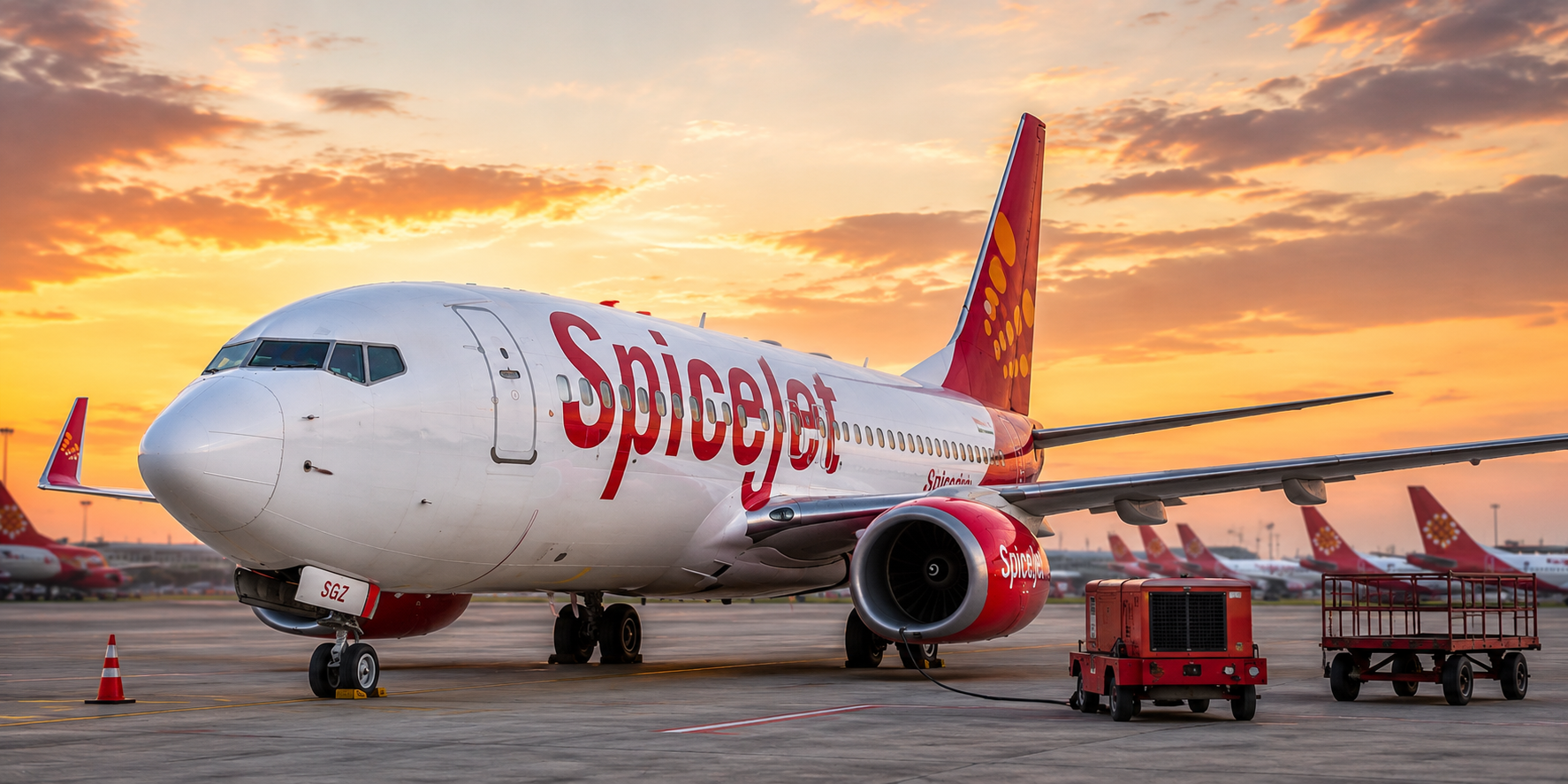
SpiceJet has stopped flying its Boeing 737 MAX aircraft for the time being, adding another setback to an airline already struggling with a shrinking fleet and mounting financial pressure.
The Indian carrier’s Boeing 737-8s have either been returned following lessor action or remain grounded, leaving the type absent from SpiceJet’s current scheduled passenger operations. While the development could easily be mistaken for another Boeing 737 MAX story, the circumstances are different. There is no indication that SpiceJet has grounded the aircraft because of a new technical or safety problem.
Instead, the move appears to be closely tied to the airline’s wider financial and fleet problems.
That distinction matters. SpiceJet once saw the 737 MAX as an important part of its future, using the aircraft to modernize its narrowbody fleet and support both domestic and international flying. Today, the airline is having to make much tougher choices about which aircraft it can realistically afford to keep in service.
SpiceJet’s 737 MAX Fleet Has Effectively Gone Quiet
SpiceJet was among the early Indian operators of the Boeing 737 MAX, taking delivery of its first 737-8 aircraft in 2018. The aircraft offered the airline greater fuel efficiency and additional range compared with older members of its 737 fleet.
For a carrier built around the economics of short- and medium-haul flying, those advantages made the MAX an obvious choice.
The situation has changed considerably since then.
Several SpiceJet 737-8 aircraft have been caught up in disputes involving leasing arrangements, payments and maintenance. Four MAX aircraft leased to the airline have also been the subject of lessor action seeking deregistration, while other aircraft have remained out of service.
Ch-aviation reported that SpiceJet had suspended Boeing 737-8 operations, with the aircraft no longer being used for scheduled passenger flights. Flight-tracking and fleet information also showed the MAX aircraft outside the airline’s active schedule.
For SpiceJet, that leaves an aircraft type that was once expected to support its growth sitting on the sidelines.
The Problem Is Not the Boeing 737 MAX Itself
The circumstances surrounding SpiceJet are important because they separate the airline’s latest move from the long-running global debate over the Boeing 737 MAX.
SpiceJet’s current situation is fundamentally an operational and financial one.
An aircraft can be perfectly capable of flying and still be unavailable to an airline. Leasing costs, maintenance requirements, overdue payments, spare parts and contractual disputes can all keep an aircraft on the ground.
That is particularly damaging for a carrier with limited financial resources.
If an aircraft is earning revenue, its operating costs can be supported by the flights it performs. When it sits idle for months, however, some of those costs remain while the revenue disappears. At that point, keeping the aircraft becomes a financial decision as much as an operational one.
That appears to be where SpiceJet now finds itself with parts of its fleet.
Lessors Have Become a Major Pressure Point
Aircraft leasing is a normal part of commercial aviation. Airlines use lessors because purchasing every aircraft outright would require enormous amounts of capital.
The arrangement works as long as the airline can meet its obligations.
SpiceJet has spent years dealing with lessors over unpaid dues and aircraft-related disputes. The pressure intensified again in 2026, with lessors seeking to take back Boeing 737 MAX aircraft that were not operating.
In some cases, the economics can make returning a grounded aircraft more attractive than continuing to carry the associated financial obligations.
That is an uncomfortable position for an airline trying to rebuild.
Instead of having the luxury of keeping aircraft available for a future recovery, SpiceJet has to decide where its limited money can have the greatest immediate impact. An aircraft that can be returned to service quickly may be more valuable than one requiring substantial maintenance expenditure before it can carry passengers again.
SpiceJet Has Far Fewer Aircraft Flying
The MAX suspension comes against a backdrop of a much broader fleet shortage.
SpiceJet had once operated a considerably larger network across India. Its fleet included dozens of Boeing 737 aircraft, and the airline was a significant player in the country’s rapidly expanding low-cost aviation market.
By 2026, however, the picture had changed dramatically.
The airline has been operating a much smaller number of flights than it had planned, with a large portion of its fleet grounded or otherwise unavailable. At one point in July, daily operations were around 85 flights, well below the more than 140 flights that had been expected under its summer schedule.
That gap is difficult to close simply by adding flights to a timetable.
Every additional service requires an aircraft, crew, maintenance support and the money to keep the operation running. When an airline does not have enough serviceable aircraft, its schedule becomes increasingly dependent on a small core of planes.
That leaves very little room for disruption.
SpiceJet’s Market Share Has Collapsed
The decline in available aircraft has also had a direct impact on SpiceJet’s position in the Indian domestic market.
The airline was once one of India’s biggest low-cost carriers. Its orange-and-red aircraft were a familiar sight at airports across the country, and SpiceJet competed aggressively with other major domestic operators.
That position has eroded.
By June 2026, SpiceJet’s domestic market share had fallen below 2%, according to industry data reported by CNBC-TV18. The decline reflects years of financial difficulties, aircraft groundings, lessor disputes and an inability to maintain the scale of operations the airline once had.
For an airline, losing market share is not simply a branding problem.
Routes can become harder to defend when frequencies are reduced. Passengers may shift to competitors if flight choices become limited. Once that happens, rebuilding demand can require additional capacity and competitive fares — exactly what a financially constrained airline may struggle to provide.
That is the trap SpiceJet is now trying to escape.
The United Comparison Shows How Different the MAX Story Can Be
The contrast with United Airlines is striking.
While SpiceJet is struggling to keep its existing Boeing 737 MAX aircraft in service, United is preparing for the arrival of the largest aircraft in the MAX family, the Boeing 737 MAX 10.
United has 167 MAX 10 aircraft on order and expects to receive its first examples in summer 2027. But even for an airline with much greater financial resources, Boeing’s certification delays have created headaches.
United CEO Scott Kirby recently joked about the airline having hundreds of specially prepared lie-flat seats sitting in storage because they were designed for the MAX 10 and cannot simply be transferred to other aircraft.
United has already moved ahead with a premium-focused subfleet of Airbus A321neo aircraft for transcontinental routes while waiting for the MAX 10. The airline’s so-called “Coastliner” aircraft feature premium seating and Polaris suites aimed at higher-yield passengers.
The comparison is revealing.
For United, the problem is how to make the most of an aircraft it expects to receive. For SpiceJet, the immediate challenge is keeping aircraft it already has access to available for passengers.
Both situations involve the 737 MAX, but they represent two very different sides of the commercial aviation market.
Why the SpiceJet Grounding Matters
SpiceJet’s Boeing 737 MAX situation is ultimately less about Boeing than it is about the airline itself.
The 737-8 remains a useful aircraft for an Indian carrier. Its range and fuel efficiency make it well suited to domestic trunk routes and international services. There is nothing inherently unusual about an airline temporarily removing an aircraft type from its schedule.
What makes SpiceJet different is the reason behind the decision.
The airline is trying to operate with a fleet that has been repeatedly reduced by groundings, maintenance problems, financial constraints and lessor actions. Every aircraft that disappears from the schedule puts additional pressure on the remaining fleet.
That can create a vicious cycle.
Fewer aircraft mean fewer flights. Fewer flights reduce available capacity. Lower capacity can restrict revenue growth. And weaker cash flow makes it harder to return grounded aircraft to service or settle outstanding obligations.
SpiceJet has attempted to break that cycle by bringing aircraft back and arranging additional leased capacity. Those measures have provided some relief, but they have not yet restored the airline to the scale it once targeted.
What Happens Next for SpiceJet?
The suspension of Boeing 737 MAX operations is not necessarily permanent.
If SpiceJet can improve its financial position, settle disputes and return more aircraft to service, the 737-8 could once again become part of its operating fleet.
For now, though, the airline has more immediate concerns.
Its priority is likely to be aircraft that can fly reliably and generate revenue without requiring an unsustainable amount of additional spending. That could mean concentrating resources on a smaller group of aircraft rather than trying to reactivate every plane in the fleet at once.
The latest MAX development therefore offers a snapshot of where SpiceJet stands today.
A few years ago, the Boeing 737 MAX represented fleet renewal and growth for the airline. Now, the absence of those aircraft from scheduled operations is another reminder of how much SpiceJet’s fortunes have changed.
The aircraft itself is not the story.
The real story is whether SpiceJet can get enough of its fleet back in the air — and keep them there.
For more on SpiceJet, see: SpiceJet Expands Fleet with 18 Boeing Aircraft Amid Heavy Losses and Fleet Revamp



Leave a Reply