
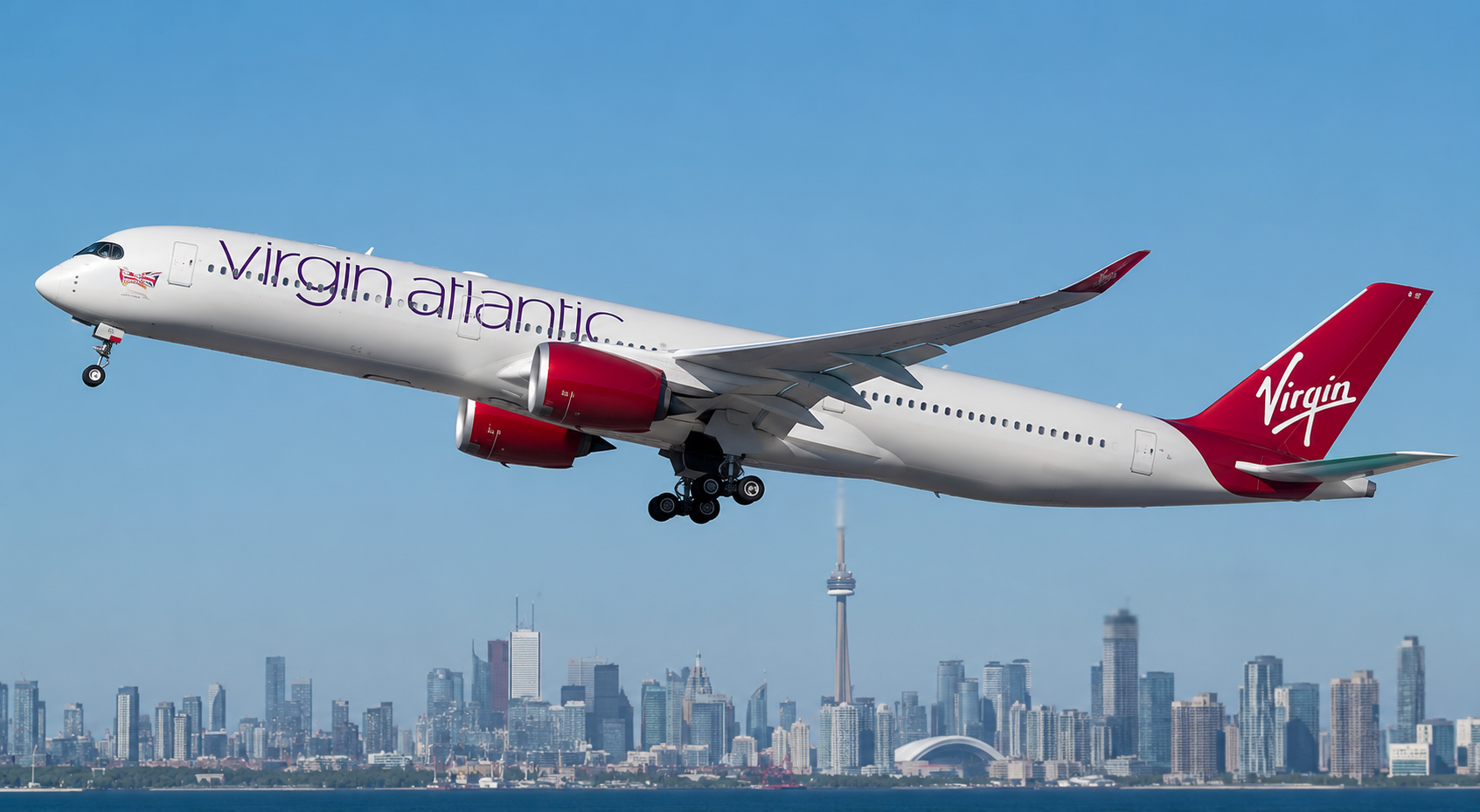
Virgin Atlantic is cutting flights between London Heathrow (LHR) and Toronto Pearson (YYZ) during the Northern Winter 2026/27 season, reducing the route to three flights a week.
The change takes effect on October 25, 2026, and will remain in place through March 27, 2027. While the airline is reducing frequency, it will continue to use its 397-seat Airbus A350-1000 on the route.
That makes the change less dramatic than a full capacity withdrawal. Toronto remains part of Virgin Atlantic’s long-haul network, but passengers will have fewer weekly departures during the winter months.
The move is also part of a wider reshaping of the airline’s winter schedule, with capacity being taken away from some North American markets and added to destinations where Virgin Atlantic expects stronger seasonal demand.
Toronto Service Drops to Three Flights a Week
Under the revised schedule, Virgin Atlantic’s VS147 will leave Heathrow at 13:05 on Mondays, Thursdays and Saturdays.
The return VS148 will depart Toronto at 20:30 on two of those days, while Saturday’s flight will leave at 21:00 before arriving in London the following morning.
The reduction takes the route from four weekly flights to three. On a typical month, that means more than 1,700 fewer seats compared with a four-times-weekly operation.
Virgin Atlantic is nevertheless keeping the larger A350-1000 rather than switching back to the Boeing 787-9.
That is significant because the Toronto route has already gone through several capacity changes since its launch. Virgin Atlantic introduced daily service between Heathrow and Toronto in March 2025. The airline later upgraded the route from the 787-9 to the 397-seat A350-1000 during the Northern Summer schedule.
The latest adjustment therefore appears to be a seasonal frequency change rather than a retreat from the Canadian market.
Virgin Atlantic Is Moving Capacity Around
Toronto is only one part of Virgin Atlantic’s winter network changes.
The airline has also made adjustments to other long-haul routes, particularly in North America. London Heathrow-Seattle (SEA) flights are being suspended for the winter, with the route expected to return during the Northern Summer.
Virgin Atlantic is also dropping its London Heathrow-Dubai (DXB) service from the winter schedule. The airline has said Dubai is expected to return in the Winter 2027/28 season.
Rather than simply reducing its overall long-haul flying, Virgin Atlantic is using the changes to free up aircraft for other markets.
That capacity is particularly visible in South Africa.
Virgin Atlantic expects to operate 10 weekly flights to Johannesburg (JNB) during the winter. The schedule will include daily Airbus A350-1000 services alongside three additional weekly Boeing 787-9 flights.
Cape Town (CPT) will also receive a substantial schedule, with 11 flights a week planned.
The shift makes sense from a seasonal perspective. The UK winter coincides with summer in South Africa, creating a strong leisure travel window. Cape Town and Johannesburg are established markets for Virgin Atlantic, and additional capacity allows the airline to make greater use of its widebody fleet during a period when demand patterns are different from those seen across the North Atlantic.
Phuket Adds More Winter Flying
Virgin Atlantic is also looking beyond its traditional transatlantic network.
From October 18, 2026, the airline is scheduled to begin three weekly flights between London Heathrow and Phuket (HKT), operated by the Boeing 787-9 Dreamliner.
Phuket gives Virgin Atlantic another leisure-focused destination for the winter timetable, when travelers from the UK typically look toward warmer destinations.
Taken together, the Toronto reduction, the Seattle suspension and the additional flying to South Africa and Phuket show a clear pattern.
Virgin Atlantic is moving aircraft between markets rather than treating every route in the same way throughout the year.
For passengers, that can mean fewer choices on some routes but more capacity on others. For the airline, it provides a way to match its fleet with changing demand without abandoning markets altogether.
Toronto Has Already Seen Rapid Growth
The latest reduction is notable because Virgin Atlantic only recently increased its presence in Toronto.
The airline’s daily service launched in March 2025, giving travelers another direct option between the UK and Canada’s largest city. The subsequent move to the A350-1000 increased the number of seats available on the route.
The decision to retain that aircraft for winter suggests Virgin Atlantic still sees value in maintaining a sizeable operation in Toronto, even if it does not need four weekly departures throughout the entire season.
For travelers, the main impact will be schedule flexibility. With three flights each week instead of four, passengers may have fewer options when planning short trips or trying to match Virgin Atlantic’s schedule with onward connections.
It also means that demand will need to be watched closely as the winter season progresses. Airlines can make further schedule adjustments when booking patterns change, although there is no indication from the current schedule that Toronto is facing a permanent withdrawal.
Virgin Atlantic Is Using AI to Improve Decision-Making
The network changes come as Virgin Atlantic is also investing in ways to make faster use of customer and market information.
The airline has been using OpenAI’s ChatGPT Work across areas including competitive research, product planning, analytics and customer experience.
Virgin Atlantic’s customer journey generates information at almost every stage, from browsing and booking to check-in, the airport experience, the flight itself and post-trip feedback. Much of that information traditionally sits across different systems and reporting tools.
The airline says ChatGPT Work is helping employees bring those sources together and spend less time manually searching through information.
That work has also been used as Virgin Atlantic developed its five-year digital strategy. The airline’s digital product team used ChatGPT Work to structure competitor research and examine customer journeys across different airlines.
Research that could previously take weeks was reduced to hours, according to Virgin Atlantic’s Head of Digital Product Nathan Bolt. The aim was not simply to gather more information, but to make it easier for teams to identify where the airline’s digital experience was performing well and where further investment was needed.
That has also fed into product planning and customer experience work.
Virgin Atlantic says its teams are using ChatGPT Work and ChatGPT Sites to create more connected views of information that was previously spread across multiple dashboards and reporting environments.
Technology and Network Planning Point to the Same Goal
There is no suggestion that ChatGPT Work directly drove the decision to reduce Toronto flights.
The two developments do, however, show how Virgin Atlantic is approaching a more competitive long-haul market.
Aircraft allocation is one of the biggest decisions an airline makes. A widebody aircraft sitting on a route with weaker seasonal demand represents an opportunity cost when another market could potentially generate better returns.
That is why seasonal network planning matters.
Virgin Atlantic can reduce frequencies on selected routes, temporarily suspend others and put the available aircraft into markets where demand is expected to be stronger. At the same time, better access to customer and competitive data can help the airline decide where digital investment and product improvements should be directed.
The combination of network flexibility and faster analysis could become increasingly important as airlines manage higher operating costs, changing travel patterns and intense competition across international markets.
Toronto Remains on the Map
For now, the message for Toronto passengers is straightforward.
Virgin Atlantic is not leaving the Heathrow-Toronto market. It is reducing winter frequency from four flights a week to three and continuing to operate the route with the Airbus A350-1000.
The bigger story is what the airline is doing with the capacity elsewhere.
Johannesburg and Cape Town are receiving strong winter schedules, while Phuket is being added to the network and other North American routes are being reduced or temporarily suspended.
That makes the Toronto cut part of a much wider network decision rather than an isolated route change.
Virgin Atlantic’s winter schedule shows an airline willing to move capacity when seasonal demand shifts. For Toronto, that means fewer weekly departures. For the airline, it creates more room to put aircraft into markets that can deliver stronger performance during the winter months.
For more on Virgin Atlantic, see: Virgin Atlantic Delays A330neo, Doubles Down on Premium








Leave a Reply