
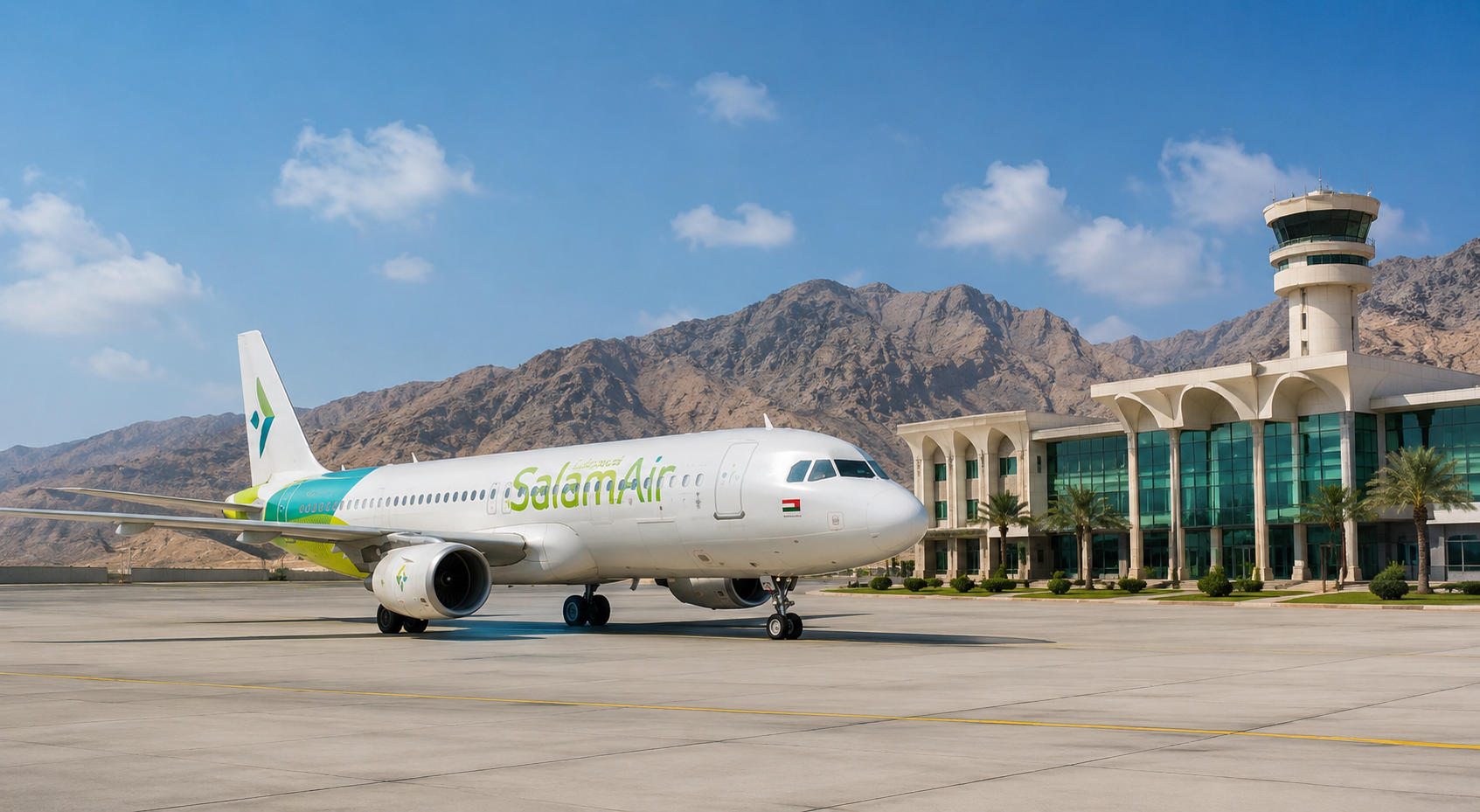
SalamAir is making a bigger commitment to southern Oman with the establishment of Salalah’s first airline base, a move that will give travelers in Dhofar more direct international flight options throughout the year.
The Omani low-cost carrier plans to launch the new operation with flights to Jeddah in Saudi Arabia, Chattogram in Bangladesh and Calicut in India. The services are expected to begin toward the end of October as part of the airline’s Winter 2026 schedule, with bookings opening on August 26.
For Salalah, the announcement is notable because the city’s aviation activity has traditionally been closely linked to the annual Khareef season. SalamAir’s decision to station an aircraft there points to a longer-term ambition: making Salalah a more important part of its international network rather than simply a destination that sees a sharp rise in capacity during the summer.
SalamAir expands its Salalah commitment
The new base builds on SalamAir’s growing presence in Dhofar. During the 2026 Khareef season, the airline increased capacity significantly on the Muscat-Salalah route, operating as many as 15 flights a day during the busiest period.
That increase added thousands of seats at a time when demand for travel to Salalah was particularly strong. The airline also introduced special fares for Omani nationals, with one-way tickets starting at OMR 9.99, supporting more affordable domestic travel during the peak season.
SalamAir’s latest announcement takes that approach a step further. Instead of scaling up and then reducing its Salalah operation after Khareef, the airline will now have an aircraft based in the city and dedicated international routes operating from there.
Adrian Hamilton-Manns, Chief Executive Officer of SalamAir, said the airline was proud to turn its long-standing commitment to Salalah and the people of Dhofar into a permanent operation.
He said the new base would strengthen direct international connectivity, give the local community more travel choices and support Salalah’s development as a year-round tourism and economic destination.
Three direct international connections
The first three routes from the new SalamAir Salalah base have been selected for markets with established travel links to Oman.
Jeddah will connect Salalah directly with Saudi Arabia, while Chattogram will provide a nonstop option for travelers heading between Dhofar and Bangladesh. The Calicut service will strengthen Salalah’s connection with India and give passengers in the region another direct route to the Indian subcontinent.
For many travelers, the appeal is straightforward. Direct flights can remove the need to travel through Muscat or another connecting airport, cutting down on journey time and making international trips less complicated.
The routes could also be particularly useful for Dhofar’s expatriate communities, many of whom maintain strong family and business connections across South Asia and the Gulf.
At the same time, direct international services can make Salalah more accessible to visitors who may otherwise have to arrange a connecting flight before reaching southern Oman.
Moving beyond the Khareef season
Salalah is one of Oman’s best-known tourism destinations, with the Khareef season playing a major role in its popularity. From roughly June to September, the southwest monsoon transforms parts of Dhofar, attracting visitors from across Oman and the wider region.
But the city has been working to develop its tourism appeal beyond those few months.
The establishment of a permanent airline base could support that effort by making it easier for visitors to reach Salalah outside the Khareef period. Dhofar’s beaches, mountains, archaeological sites, wadis and desert landscapes offer attractions throughout the year, and better connectivity can help bring more attention to them.
More visitors could also have a wider economic impact. Hotels, restaurants, tour operators, car rental companies and other tourism-related businesses all stand to benefit from a steadier flow of travelers rather than demand being concentrated around one seasonal window.
SalamAir brings Airbus A320neo and A321neo aircraft
The new Salalah services will be operated using SalamAir’s Airbus A320neo and A321neo aircraft.
The airline currently operates a fleet of 18 aircraft, giving it room to manage capacity across its network while responding to changing passenger demand. The A320neo and A321neo are already central to SalamAir’s operations and are suited to the regional international routes being introduced from Salalah.
Having an aircraft based in the city also gives SalamAir greater operational flexibility. Rather than relying entirely on aircraft arriving from another base, the airline will have capacity positioned locally to support its Salalah schedule.
That could become increasingly useful if demand grows or if the carrier decides to add more routes in the future.
What the Salalah base could mean for travelers
The immediate change for passengers will be the availability of more direct Salalah flights. Travelers heading to Jeddah, Chattogram or Calicut will have another option for reaching their destinations without making a connection elsewhere.
The longer-term significance, however, may be even greater.
An airline base can provide a foundation for network growth. If the initial routes perform well, SalamAir could have an opportunity to increase frequencies or consider additional international destinations from Salalah.
That does not guarantee further route launches, but the decision to station an aircraft in the city gives the airline a stronger platform from which to assess future opportunities.
It also represents a shift in how Salalah fits into SalamAir’s network. The city is no longer being treated only as a destination requiring extra capacity during Khareef. It is becoming a base from which the airline can build a regular international operation.
A significant step for Dhofar aviation
For Salalah and the wider Dhofar region, SalamAir’s decision represents a meaningful development in air connectivity.
The three initial destinations—Jeddah, Chattogram and Calicut—serve important passenger markets, while the permanent base provides room for the airline to develop its presence further.
The timing also comes after a strong Khareef season for SalamAir, during which the carrier demonstrated its willingness to add substantial capacity to meet demand. The new base builds on that experience while taking the airline’s relationship with Salalah into a new phase.
For travelers, the benefit is more choice. For tourism businesses, it means another route to international markets. And for Salalah itself, the arrival of a dedicated airline base reinforces its position as one of Oman’s key aviation and tourism gateways.
As the new services begin with the Winter 2026 schedule, all eyes will be on passenger demand. If the routes gain traction, SalamAir’s first Salalah base could become the starting point for a much broader international network from southern Oman.
For more on SalamAir, see: Oman Air and SalamAir Face Major CEO Changes


Leave a Reply