
United’s Economy Cabin Is Getting a Different Kind of Upgrade
There is only so much comfort an economy seat can provide when a flight lasts nine, 10 or even 12 hours.
Passengers can recline their seats, adjust a headrest and try to find a comfortable position, but the basic problem remains: there simply is not much room to move. That can be particularly difficult for larger travelers, who may find that the standard economy seat creates discomfort long before the aircraft reaches its destination.
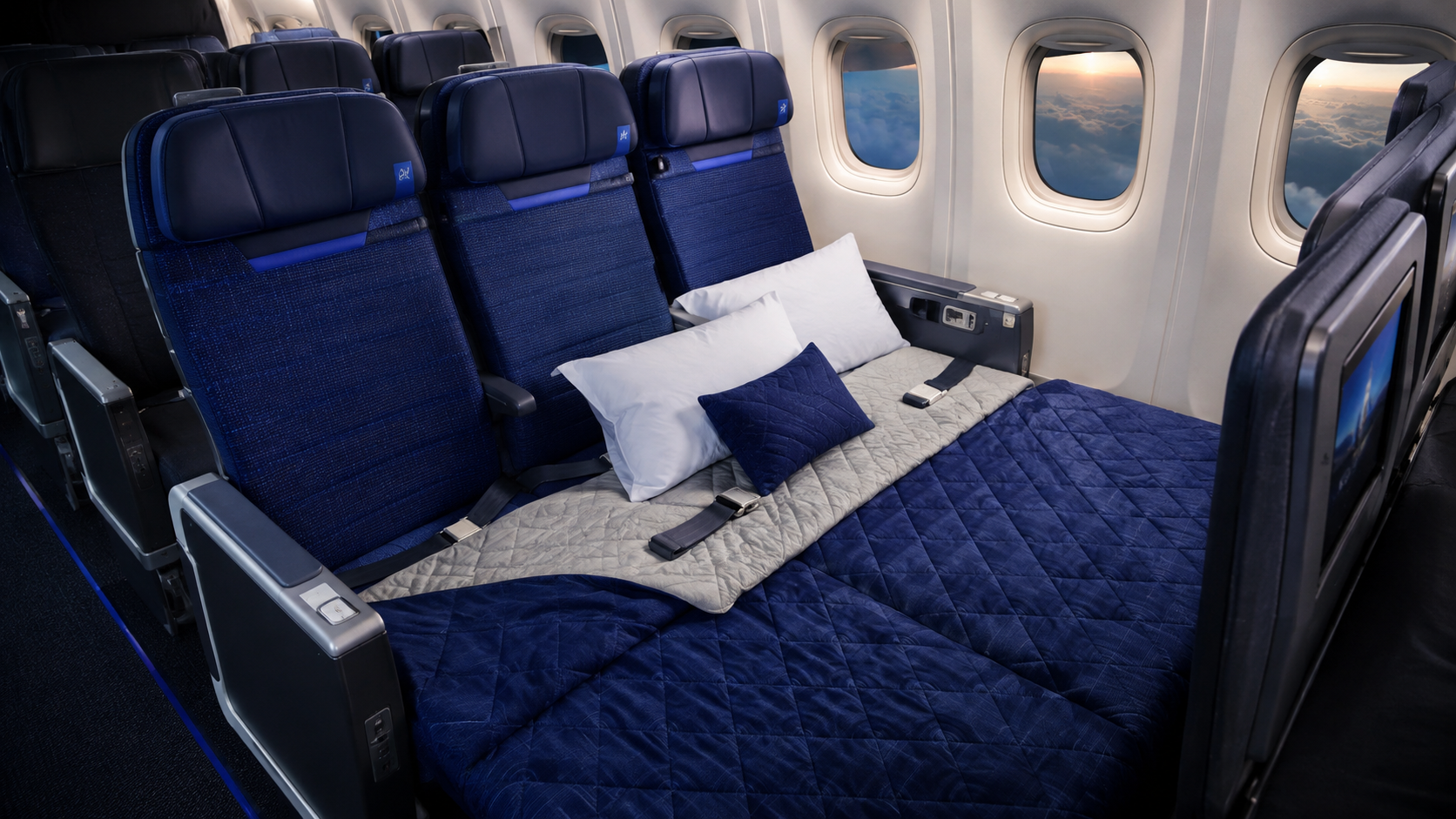
United Airlines is taking a different approach with its upcoming Relax Row.
Rather than redesigning a single economy seat, the airline is combining three seats into a larger space that passengers can use to stretch out after takeoff. The seats are fitted with adjustable leg rests that fold upward, creating a couch-like, mattress-style surface.
The product is scheduled to enter service in 2027, with United planning to install it on more than 200 Boeing 787 and Boeing 777 aircraft by 2030. Each aircraft could have as many as 12 Relax Row sections.
The idea has already caught the attention of plus-size travelers, and one travel writer’s reaction shows why the concept could appeal to a much wider audience than United initially suggests.
Why the Relax Row Matters to Plus-Size Travelers
Travel journalist and author Robin Raven recently shared her reaction to United’s new economy product after reflecting on an uncomfortable transatlantic flight.
Her experience highlights a problem that can be easy to overlook when airlines talk about seat dimensions.
During a roughly nine-hour flight to Europe, Raven described dealing with a seatbelt buckle pressing against her side and having the passenger next to her repeatedly intrude into her personal space. The situation became more uncomfortable when the passenger in front reclined, leaving her with less room to eat.
Even getting to the lavatory was difficult. Raven said the entrance was narrow enough that she had to turn sideways to get inside.
None of these problems can necessarily be solved by adding another inch of seat pitch.
That is where the Relax Row becomes interesting.
Once the three seats are converted, the passenger is no longer dealing with one narrow seating area in quite the same way. The available space becomes a larger surface that can be used for sleeping or simply stretching out.
For someone who regularly finds a conventional economy seat restrictive, that difference could be significant.
Raven’s response focused on that sense of freedom. She praised the idea of having enough room that passengers would not constantly have to think about sharing an armrest, bumping into the person beside them or trying to find a comfortable position.
United is not marketing the Relax Row specifically as a solution for plus-size passengers. However, the reaction demonstrates how the product could address a genuine concern among travelers who find conventional economy seating uncomfortable.
How United’s Relax Row Will Work
The concept itself is relatively simple.
Passengers will reserve three seats in a designated Relax Row section. After takeoff, the individual leg rests can be raised to create a larger, flatter area across the row.
That space is intended for resting and sleeping rather than simply providing passengers with a more generous conventional seat.
United is also including several amenities to make the experience feel more complete.
Passengers using the Relax Row will receive a custom-fitted mattress pad, a specially sized blanket and two additional pillows. Families will receive a Children’s Travel Kit as well as a plush toy.
Those extras matter because the product is not just about adding physical space. United is trying to create an environment where passengers can actually use that space to rest during a long international flight.
The airline plans to position Relax Row between standard United Economy and United Premium Plus.
That makes the product something of a middle option. Passengers who do not want to remain in a standard economy seat for an entire overnight flight will have another choice, without necessarily stepping up to a premium cabin.
The Price Could Determine Its Success
There is one major piece of the puzzle that United has yet to reveal: the price.
Until the airline announces how much passengers will pay for a Relax Row, it is difficult to judge exactly how attractive the proposition will be.
The concept makes sense if the additional cost remains comfortably below the price of upgrading to a premium cabin. If the price gets too close to Premium Plus or business class, some travelers may simply choose the conventional upgrade instead.
That will be particularly relevant for passengers traveling alone.
A family or couple can spread the cost of three seats across several people, potentially making the arrangement easier to justify. A solo traveler, meanwhile, would have to decide whether the additional space is worth paying for an entire row.
Still, the product fills an obvious gap.
There are plenty of travelers who would like more room on a long-haul flight but do not necessarily need or want everything that comes with a premium cabin.
For those passengers, the Relax Row could be a useful compromise.
Families Could Benefit Too
United is also looking beyond solo travelers.
Families flying overnight with young children could find the extra space particularly useful. A child who struggles to sleep upright in a conventional economy seat could have a much larger area in which to rest once the Relax Row is converted.
That fits with other steps United has taken to make family travel easier.
The airline has been working to keep children under 12 seated next to an accompanying adult at no additional charge when eligible. Its seating system can make adjustments to help families remain together.
United has also brought back children’s meal options on select flights, while its inflight entertainment system offers movies and programs aimed at younger passengers.
The airline’s Children’s Travel Kit, created with Sesame Street, adds another family-focused touch. The kit includes activities and other items intended to keep children occupied during a flight.
The Relax Row takes that strategy in a slightly different direction.
Instead of simply helping families manage a flight, it gives them an additional way to use the physical space inside the aircraft.
United Is Not the First Airline to Try It
The idea of turning several economy seats into a larger resting surface is not entirely new.
Air New Zealand’s Economy Skycouch has already established a similar concept, allowing passengers to reserve multiple seats and create a larger space for relaxation.
United is bringing its own version to a major North American carrier, with plans for a substantial rollout across its long-haul fleet.
That planned scale is worth watching.
United expects the Relax Row to eventually appear on more than 200 Boeing 787 and Boeing 777 aircraft, with up to 12 sections on each aircraft. The rollout is expected to begin in 2027 and continue through 2030.
That suggests the airline believes there is enough demand for an economy product built around space rather than simply incremental seat improvements.
More Than Just a Bed in Economy
It would be easy to look at the Relax Row and see it simply as an economy-class bed.
There is more to the idea than that.
For larger travelers, the appeal may be having room to change position without feeling confined to a narrow individual seat. For families, the extra surface could make an overnight flight easier to manage. For couples, it creates another option for sharing a long journey.
And for many other passengers, the biggest attraction may simply be the ability to sleep without remaining folded into a conventional economy seat.
United’s EVP and Chief Commercial Officer Andrew Nocella described the Relax Row as part of the airline’s effort to give economy passengers more space and comfort on long-haul flights. He also pointed to the product as a differentiator for United in the North American market.
Whether that ambition translates into strong demand will depend on the details.
The usable dimensions of the converted space will matter. So will seatbelt arrangements, access to the aisle and, perhaps most importantly, the price.
Those answers will come closer to the product’s launch.
For now, though, the reaction from travelers like Raven suggests United may have identified an important weakness in the traditional economy experience.
Airlines have spent years adding premium seats and creating new cabin categories for passengers willing to pay more. The Relax Row takes a different route: it keeps passengers in economy while changing what those three seats can actually do.
If United can keep the cost within reach, that could prove to be the product’s biggest selling point.
For passengers who find standard economy too restrictive but business class too expensive, the Relax Row may offer something that has been missing for years — a realistic middle ground on long-haul flights.
For more on United Airlines, see: United Airlines Restores Service After IT Outage

Leave a Reply