
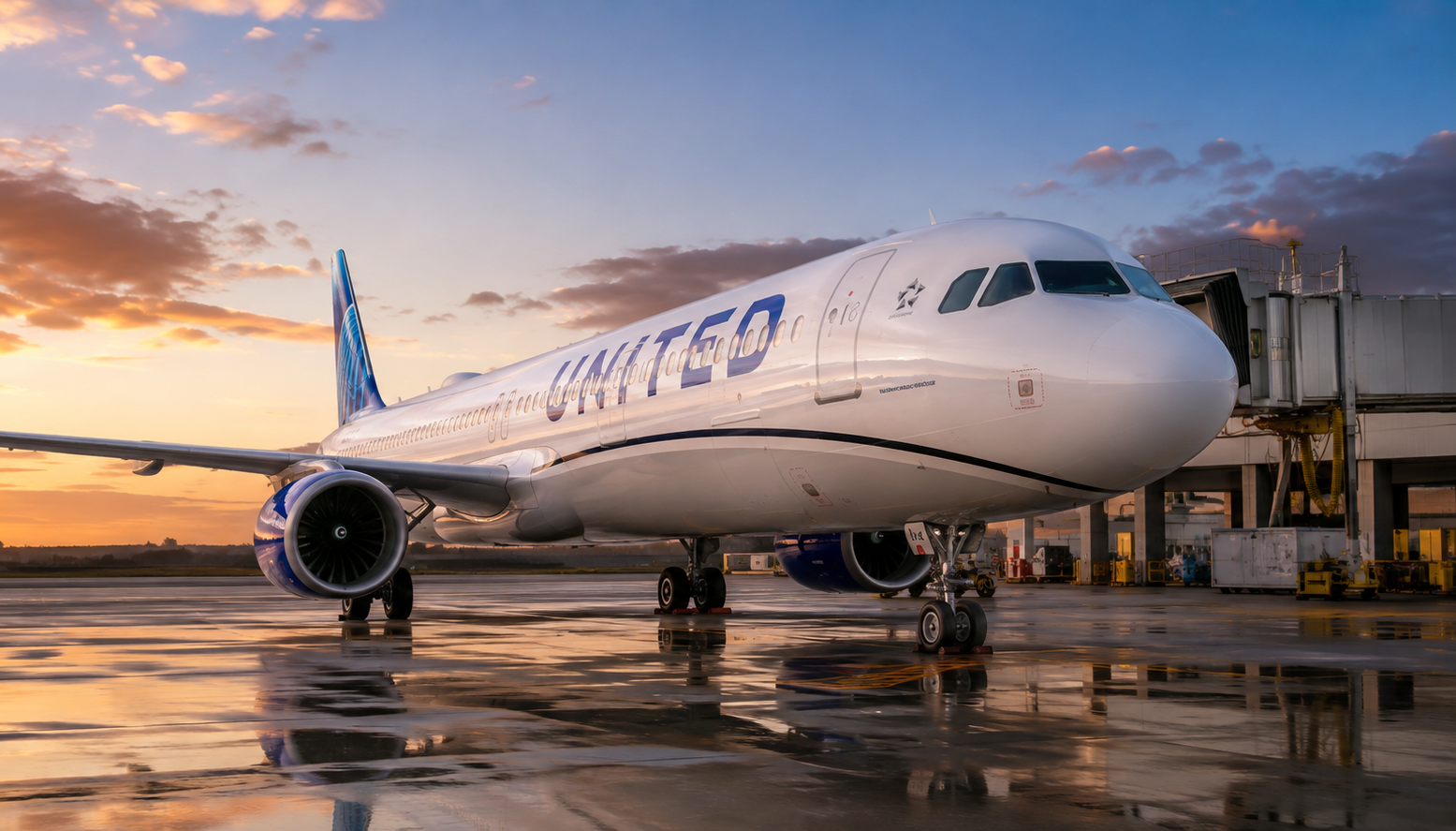
For decades, the Boeing 757 occupied a peculiar but extremely important position in the airline industry. It was a narrowbody aircraft, yet its range allowed airlines to stretch beyond the limits normally associated with single-aisle jets. For United Airlines, that capability helped make thinner transatlantic routes possible without having to fill a much larger widebody aircraft.
That era is now entering its final chapter.
United Airlines has taken delivery of its first Airbus A321XLR, registered N64321, marking the beginning of a 50-aircraft order that could fundamentally change the way the airline approaches long-haul flying. The aircraft is not simply another addition to United’s fleet. It is a replacement for one of the carrier’s most useful aircraft types and, potentially, a tool for opening an entirely new group of international markets.
The significance of the United Airlines A321XLR goes beyond its ability to fly farther than a conventional narrowbody. The aircraft gives United a combination of range, capacity and premium seating that could allow the carrier to pursue routes that would be difficult to justify with a traditional widebody.
That could prove especially important as United looks to expand its international network without adding unnecessary capacity.
United’s A321XLR Has a Big Job Ahead
The arrival of N64321 represents the start of a major transition for United.
For years, the airline’s Boeing 757-200 fleet provided the flexibility needed to connect the United States with destinations that did not generate enough demand to support a larger aircraft. The 757 became particularly valuable on transatlantic routes, where its relatively small cabin could be matched with the demand available in secondary European markets.
But the aircraft is now approaching the end of its operational life.
Replacing the 757 with another narrowbody was not necessarily a straightforward decision. A replacement aircraft needed enough range for long international sectors while also providing the economics necessary to make those flights profitable.
The Airbus A321XLR is designed specifically for that role.
With a published range of up to roughly 4,700 nautical miles, the aircraft can operate sectors far beyond the typical mission profile of an ordinary A320-family aircraft. Its additional fuel capacity, including the permanent rear center tank, gives airlines considerably more flexibility on longer routes.
For United, that means the A321XLR can potentially take over many of the missions previously associated with the 757 while offering a substantially newer aircraft platform.
The bigger question is what United does with the capability once the replacement process is underway.
The A321XLR Is More Than a 757 Replacement
Calling the Airbus A321XLR a Boeing 757 replacement is accurate, but it does not tell the entire story.
The more interesting possibility is that United could use the aircraft to expand its international network rather than simply replace existing capacity one-for-one.
A widebody aircraft can be expensive to operate on a route with limited demand. Even when a market has enough passengers to support nonstop service, filling hundreds of seats consistently can be difficult outside peak travel periods.
That is where the A321XLR changes the equation.
Instead of choosing between a smaller aircraft with insufficient range and a widebody with too many seats, United has another option. It can operate a long-range narrowbody with a smaller overall cabin while dedicating a significant portion of that cabin to premium passengers.
That distinction matters.
A route does not necessarily need huge passenger volumes to work if a sufficient number of travelers are willing to pay for premium seats. United’s A321XLR configuration appears to reflect precisely that philosophy.
A Premium Cabin Inside a Narrowbody
United’s first A321XLR has a 150-seat configuration, but the headline number is arguably less important than how those seats are distributed.
The aircraft features 20 Polaris business class suites and 12 Premium Plus seats, giving the narrowbody a substantial premium component.
That is a significant change from the traditional image of a single-aisle aircraft flying internationally.
The Polaris seats provide a lie-flat business-class product, while Premium Plus gives United a dedicated premium economy offering on the A321XLR. Together, the two cabins give the airline more opportunities to generate higher revenue from a relatively small number of passengers.
This is particularly important on thinner international routes.
A flight between the United States and a major European gateway may have strong demand but still struggle to fill a widebody aircraft year-round. With the A321XLR, United can reduce the number of seats it needs to sell while protecting its premium revenue opportunity.
That creates a very different calculation for network planners.
The aircraft is therefore not merely about carrying fewer passengers. It is about carrying the right mix of passengers.
Newark and Washington Could Become Key A321XLR Hubs
United’s East Coast network is likely to be particularly important as the A321XLR enters service.
Newark Liberty International Airport (EWR) is already one of the airline’s most important international gateways. Its position in the New York metropolitan market gives United access to substantial business and leisure demand, while its extensive connecting network can feed passengers into international services.
Washington Dulles International Airport (IAD) offers another opportunity.
The airport has long been an important part of United’s international network, but the A321XLR could allow the airline to experiment with city pairs that would not necessarily justify a larger aircraft.
That is where the aircraft’s flexibility becomes valuable.
United does not need every international destination to support a large daily widebody operation. Instead, it can potentially tailor frequencies and aircraft size to the market.
A seasonal European route could operate during periods of stronger demand and potentially be adjusted during quieter months. A secondary destination could receive nonstop service without requiring the airline to commit a widebody aircraft to the route.
This approach could also allow United to make better use of its existing airport infrastructure.
The Aircraft Could Open More Secondary European Markets
The A321XLR’s most obvious opportunity may be across the Atlantic.
Major European cities such as London, Frankfurt and Paris generate enough demand to support widebody aircraft and are likely to remain important parts of United’s international network.
But there is another tier of destinations.
Cities such as Faro, Reykjavík and Tenerife represent the type of markets where demand can be strong but highly seasonal. A large aircraft may create too much capacity during weaker periods, while a conventional narrowbody may not have sufficient range for a nonstop flight from the United States.
The A321XLR sits between those two extremes.
That makes it possible for United to consider international routes based on actual market demand rather than forcing every city into a widebody-or-connection model.
For passengers, the difference could be substantial.
Instead of connecting through London, Frankfurt or another major European hub, travelers could eventually have more opportunities to fly nonstop from a United hub to a secondary destination.
That is one of the reasons the United Airlines A321XLR could become more significant than the aircraft’s relatively modest passenger capacity suggests.
Range Is Only Half the Story
The A321XLR’s range is the feature that attracts the most attention, but the aircraft’s economics are arguably just as important.
The aircraft incorporates additional fuel capacity and structural modifications that allow it to handle longer missions. Its maximum takeoff weight is around 101 metric tonnes, while upgraded landing gear, braking systems and other structural changes support its extended-range role.
The aircraft can also be powered by CFM International LEAP-1A engines, which are designed to deliver strong efficiency compared with older-generation powerplants.
For United, the combination is important because long-haul flying puts considerable pressure on operating costs.
Fuel, maintenance, crew costs and airport expenses all affect whether a route makes sense. An aircraft that can fly the required distance while carrying fewer passengers than a widebody gives the airline another way to control those costs.
The A321XLR therefore represents an economic tool as much as an aircraft upgrade.
What Happens to United’s Boeing 757s?
The 757 has been one of the most distinctive aircraft in United’s fleet, particularly because of its ability to combine narrowbody economics with unusually long range.
Its retirement will inevitably leave a gap.
The A321XLR is designed to fill much of that gap, but it also changes the possibilities available to United. The airline is not simply replacing an older aircraft with a newer one. It is acquiring a platform that can potentially perform a broader range of missions.
That distinction could influence the future of United’s international network.
The 757 helped United serve thin routes because the aircraft itself was unusually capable. The A321XLR takes that concept further by pairing long range with a modern cabin and a premium-heavy configuration.
If the economics work as expected, United could have considerably more freedom when deciding which international markets deserve nonstop service.
The Biggest Opportunity May Be Routes That Do Not Exist Yet
This is where the A321XLR story becomes particularly interesting.
The most important routes for the aircraft may not be the ones currently operating with 757s.
They could be routes that were never launched because the numbers did not work.
Airline network planning is fundamentally about matching supply with demand. A destination may have enough passengers for a nonstop flight, but not enough to fill a widebody aircraft consistently. Historically, that has often meant relying on connections through major hubs.
The A321XLR offers a third option.
United could use smaller long-range aircraft to test new markets with less financial exposure. If a route performs strongly, the airline could increase frequency or eventually consider larger equipment. If demand is weaker than expected, the aircraft can be redeployed elsewhere.
That flexibility is difficult to achieve with a large widebody fleet.
United’s International Strategy Could Become More Fragmented
The introduction of the A321XLR also fits a broader shift taking place across the airline industry.
For much of the modern jet age, international networks were built around large hubs and high-capacity aircraft. Passengers from smaller cities would connect through major gateways before continuing to Europe, Asia or other distant destinations.
Long-range narrowbodies are challenging that model.
Airlines can now consider more direct city pairs without needing enormous passenger volumes. Instead of concentrating every international traveler into a handful of mega-routes, carriers can distribute capacity across a larger number of smaller markets.
For United, that could mean more point-to-point opportunities from Newark, Washington Dulles and other major hubs.
The result would not necessarily be the end of the hub-and-spoke system. United’s major hubs will remain essential to its network. But the A321XLR gives network planners another layer of flexibility within that system.
The Passenger Experience Will Be Closely Watched
There is one important question that the economics alone cannot answer: how will passengers respond to long-haul travel on a narrowbody?
The A321XLR is technically capable of flying across the Atlantic, but passenger expectations have changed considerably.
A long flight on a single-aisle aircraft can feel different from traveling aboard a widebody. There is less cabin width, fewer aisles and a different overall environment.
United’s premium-heavy configuration is clearly designed to address some of those concerns.
With Polaris suites, Premium Plus seating and modern connectivity, the airline is attempting to make the aircraft competitive not just on price but also on the quality of the onboard product.
If passengers accept the experience, the A321XLR could become an important part of United’s international fleet strategy.
If travelers strongly prefer widebody cabins on longer sectors, however, the airline may need to be more selective about where it deploys the aircraft.
United’s 50-Plane Commitment Could Change the Network
The scale of United’s A321XLR order is another reason to watch what happens next.
One aircraft can support a route experiment.
Fifty aircraft can support a network strategy.
As more A321XLRs enter the fleet, United will have the ability to gradually increase its exposure to long-range narrowbody flying. That could include replacing existing 757 missions, adding secondary European destinations and potentially exploring other international markets where demand is too thin for conventional widebody operations.
The aircraft also gives United more options when demand changes.
That flexibility may ultimately be its biggest advantage.
Airlines rarely operate in stable conditions. Fuel prices change, economies slow down, consumer demand shifts and geopolitical events can quickly alter international travel patterns. An aircraft that can move between long-haul international missions and other routes gives an airline more ways to respond.
A New Chapter for United’s Long-Haul Fleet
United Airlines’ first Airbus A321XLR is important because it represents more than the arrival of a new aircraft type.
It marks a change in how the airline can think about international growth.
The Boeing 757 proved that a narrowbody could successfully cross the Atlantic when the aircraft had the right range and the market was carefully selected. The A321XLR takes that idea into a new generation, adding greater range capability, a modern airframe and a premium-focused cabin.
United now has the opportunity to use that combination to reshape its international network.
The first phase will likely involve replacing aging 757s and establishing the aircraft on carefully selected routes. But the larger opportunity lies beyond replacement. If the A321XLR delivers the expected economics and passengers embrace its long-haul cabin, United could begin serving international destinations that previously fell into an awkward gap between a narrowbody and a widebody.
That would make the A321XLR one of the most strategically important aircraft in United’s fleet.
The real test is still ahead.
United will need to demonstrate that a 150-seat aircraft can generate enough premium revenue, maintain strong utilization and deliver reliable performance on demanding long-haul missions. If it succeeds, the airline may discover that it does not need bigger aircraft to grow its international network.
It may simply need more aircraft that are the right size.
And that could make United’s Airbus A321XLR far more than a replacement for the Boeing 757. It could become the aircraft that changes where United believes a nonstop international route is possible.
For more on similar developments, see: United Eyes New A321XLR Seating Concept With Blocked Middle Seats





Leave a Reply