
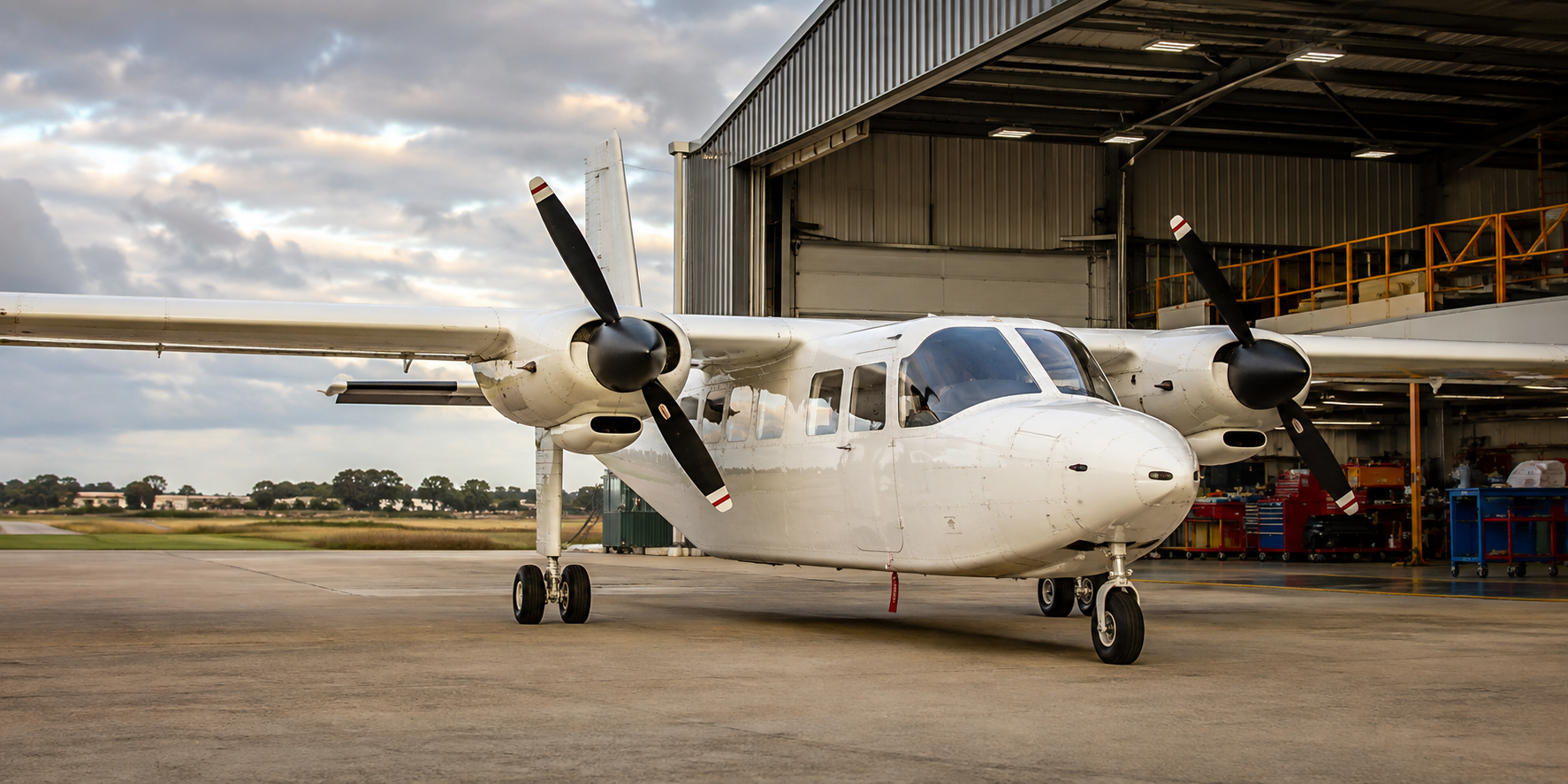
For an aircraft design that first flew more than six decades ago, the Britten-Norman Islander is entering a remarkably modern chapter. The latest aircraft has begun ground testing at the manufacturer’s historic Bembridge facility on the Isle of Wight, putting it on course for a first flight in September and eventual delivery to the Falkland Islands Government Air Service (FIGAS).
The milestone is about more than another Islander leaving the factory. This aircraft is the first to pass through Britten-Norman’s fully reshored UK production line as a complete aircraft, representing the company’s effort to rebuild domestic manufacturing capability around one of Britain’s best-known utility aircraft.
Britten-Norman officially brought Islander production back to the UK after previously relying on overseas manufacturing for major assemblies before final assembly in Britain. The new Bembridge operation is intended to give the company greater control over production, strengthen its supply chain and create the capacity for a more consistent flow of new aircraft.
First UK-built Islander moves into testing
The aircraft, currently registered as G-FRZT, was rolled out at Britten-Norman’s Isle of Wight facility on July 30. That followed the successful application of electrical power to the aircraft a day earlier, another important step towards bringing the new airframe to life.
By the time of the rollout, much of the major assembly work had been completed. The aircraft had received its engines and propellers, along with cowlings, electrical systems, brakes and the various flight-control surfaces and mechanisms.
The progress came after the airframe reached 75% structural completion in June. At that stage, Britten-Norman had already completed and installed the 15-metre wing assembly, joined major fuselage components and advanced work on the undercarriage, engines and aircraft systems.
The focus has now shifted from assembly to proving the aircraft on the ground before it moves into flight testing.
That makes September’s planned first flight the next major milestone for a project that has been building steadily since the company restarted full aircraft production at Bembridge.
Why the return of Islander production matters
The most significant part of the story is arguably taking place inside the factory rather than on the runway.
Britten-Norman’s decision to bring complete Islander production back to the Isle of Wight required new investment in machinery, tooling, facilities and manufacturing capability. The company has also expanded its workforce by more than 40% since the current production programme began.
The aim is not simply to complete one aircraft and declare the project finished. A second airframe is already progressing through the production line, while components for subsequent aircraft are being manufactured.
That points to a broader ambition: establishing a continuous UK production cadence rather than treating the new-build Islander as a one-off programme.
For British aerospace manufacturing, that distinction matters. Rebuilding an aircraft production line involves more than assembling an airframe. It requires suppliers, skilled workers, tooling, quality systems and engineering knowledge to operate together consistently. Britten-Norman’s investment at Bembridge is therefore intended to create an industrial capability that can support multiple aircraft over the longer term.
The company has previously said that bringing production home would improve control of manufacturing, increase output and provide greater reliability across its supply chain. It has also indicated plans to significantly increase new-aircraft production from the UK facility.
From the Isle of Wight to the Falkland Islands
Once testing and customer preparation are complete, the new Islander will head for the South Atlantic.
The aircraft has been contracted to FIGAS, an operator with a particularly strong connection to the Islander. The Falkland Islands Government Air Service has relied on the type for decades, using it to connect communities spread across the remote island territory.
For FIGAS, the aircraft is more than an addition to a fleet. Air services in the Falklands support a range of essential activities, including passenger transportation, medical flights, freight, postal services and other community and government operations.
The Falklands are also precisely the sort of environment in which the Islander’s original design philosophy remains relevant. Long runways and extensive airport infrastructure are not always available, making an aircraft capable of operating from short and demanding airstrips particularly valuable.
Britten-Norman says FIGAS’s existing fleet of Islanders has played an important role in maintaining connections across the islands. The operator has also selected new Islanders as part of its wider fleet-modernisation plans, reflecting the aircraft’s suitability for the challenging local operating environment.
A 60-year-old design with a new manufacturing future
The Islander first flew from Bembridge in June 1965. Six decades later, the aircraft continues to occupy a distinctive position in aviation because of its ability to perform missions that larger regional aircraft are not necessarily designed to handle.
Britten-Norman says more than 1,250 Islanders have been built, with aircraft operating across more than 100 countries and six continents. The manufacturer also highlights the type’s roughly 20 million accumulated flight hours.
Its appeal has always been relatively straightforward: the Islander is a practical aircraft designed around utility rather than glamour.
Its twin-engine configuration, rugged construction, low operating costs and short take-off and landing capability have made it useful in remote and infrastructure-limited locations. Operators have used Islanders for passenger services, government missions, specialist operations and other roles where reliability and access matter more than speed or size.
The new aircraft retains that established philosophy while benefiting from contemporary manufacturing processes and updated equipment. Britten-Norman’s current Islander can be fitted with modern glass-cockpit avionics, including Garmin systems, while remaining based on the proven airframe concept.
That combination is central to the aircraft’s continued appeal. Rather than replacing a familiar design simply because it is old, Britten-Norman has continued refining the Islander for operators whose requirements have not fundamentally changed.
The next test is in the air
Ground testing is now the immediate priority at Bembridge. The work will allow Britten-Norman to check the aircraft’s systems and prepare it for the transition into flight testing.
If the programme remains on schedule, G-FRZT will take to the air for the first time in September.
The first flight will be an important moment for the aircraft itself, but also for the production programme behind it. A successful flight-test campaign would demonstrate that the resurrected UK manufacturing process has progressed from tooling and assembly to delivering a complete, airworthy aircraft.
After flight testing, the aircraft will undergo the final preparations required before it is handed over to FIGAS.
Meanwhile, work is continuing behind it. With a second airframe already moving through the factory and parts for additional aircraft entering production, Britten-Norman is trying to turn the return of Islander manufacturing into a sustained operation.
That could prove to be the more important story in the years ahead.
The Islander has already survived generations of aviation technology, changing airline economics and the movement of manufacturing around the world. Now, as its latest example prepares for its first flight, the aircraft is also becoming a symbol of something else: the attempt to rebuild a British aircraft-production capability around a design that has remained useful long after many of its contemporaries disappeared.
For Britten-Norman, the September flight will therefore be more than a test of one new Islander. It will be a test of whether a historic aircraft and a revived British production line can move confidently into their next chapter.
For more on Britten-Norman, see: Britten-Norman Delivers First Islander to Guyana









Leave a Reply