
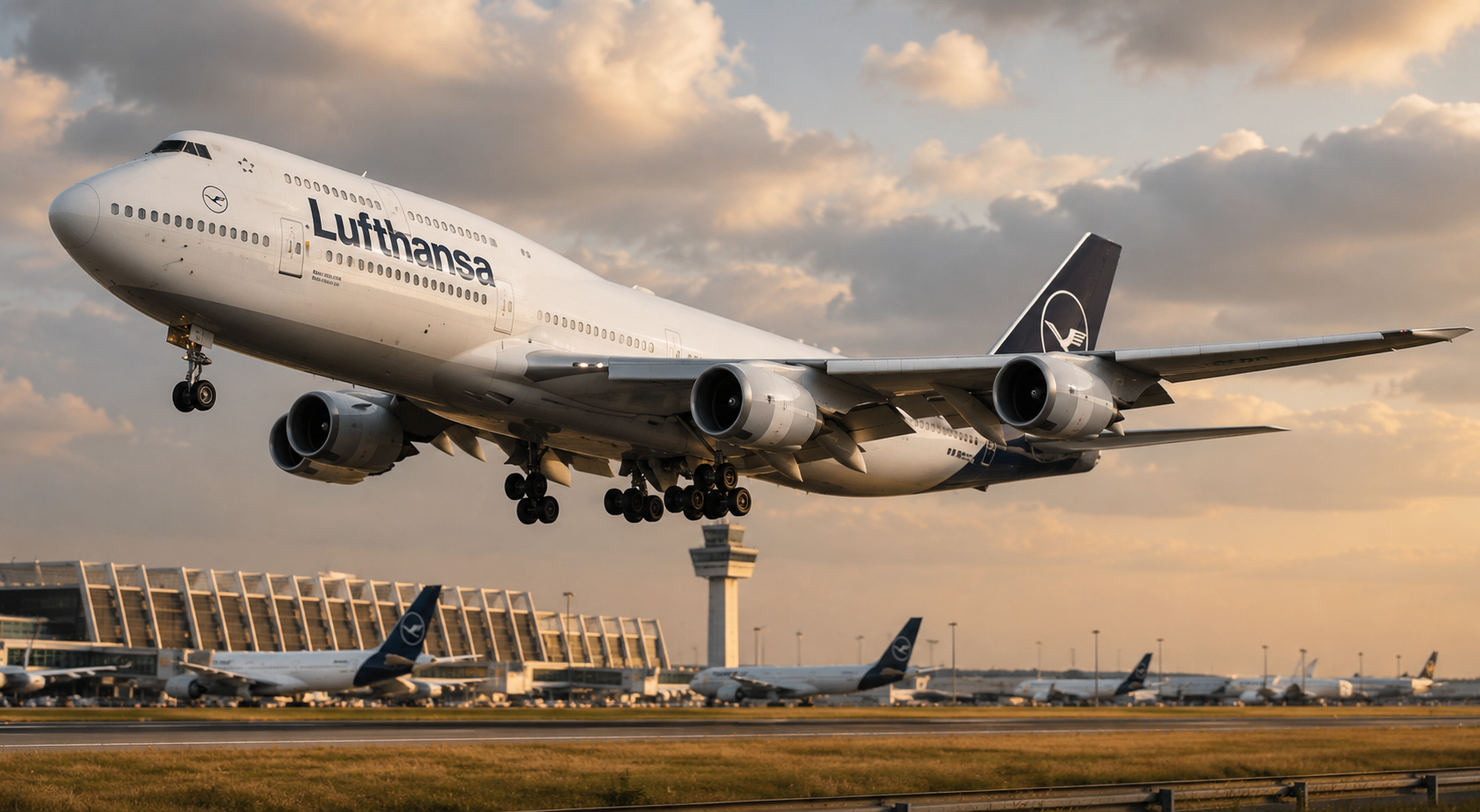
Lufthansa Boeing 747-8 Fleet Faces Two Emergency Diversions in 24 Hours
Lufthansa endured an eventful end to June after two of its flagship Boeing 747-8 aircraft were forced to abandon scheduled transatlantic flights within just 24 hours of each other. Although the incidents were unrelated, both resulted in unusual overweight landings, a procedure that is uncommon in commercial aviation but sometimes unavoidable during emergencies.
The twin diversions occurred on consecutive days during departures from Frankfurt Airport, disrupting flights bound for the United States and drawing attention to the complex decisions flight crews must make when unexpected situations arise shortly after takeoff.
Despite the seriousness of both emergencies, each aircraft landed safely without injuries related to the aircraft operations themselves, demonstrating the effectiveness of Lufthansa’s flight crews and established emergency procedures.
Two Separate Emergencies, One Unusual Outcome
The first incident took place on June 26, 2026, involving Lufthansa Flight LH418, which was operating from Frankfurt to Washington Dulles International Airport.
Shortly after departure, a passenger reportedly suffered a medical emergency that required immediate attention. Rather than continuing across the Atlantic, the flight crew elected to divert to Cologne Bonn Airport, allowing medical personnel to reach the affected passenger as quickly as possible.
Because the aircraft had only recently departed, it was still carrying nearly its full fuel load for the long-haul journey to the United States. Under normal circumstances, long-range aircraft burn a significant amount of fuel before reaching their certified maximum landing weight.
In this case, however, there was insufficient time or suitable airspace to conduct fuel dumping before landing. The crew therefore performed an overweight landing, bringing the aircraft safely onto the runway despite exceeding its standard landing weight.
The aircraft taxied to the terminal under its own power following the landing.
Another Diversion the Following Day
Less than 24 hours later, Lufthansa encountered another operational challenge involving a different Boeing 747-8.
On June 27, 2026, Flight LH402 departed Frankfurt for Newark Liberty International Airport. Shortly after takeoff, the flight crew received an engine warning indication.
Following standard operating procedures, the pilots decided the safest course of action was to discontinue the flight and return to Frankfurt rather than continue across the Atlantic with a potential engine issue.
Just as in the previous day’s incident, the aircraft had departed only minutes earlier and remained heavily fueled for the nearly nine-hour journey to the United States.
Fuel dumping was again considered impractical due to the aircraft’s position and the urgency of the return. As a result, the Boeing 747-8 completed another controlled overweight landing before safely taxiing off the runway.
While both diversions shared the same operational outcome, their causes were entirely different—one stemming from a passenger medical emergency and the other from a technical indication involving the aircraft’s propulsion system.
Aircraft Involved in the Incidents
The first aircraft involved was Boeing 747-8 registration D-ABYC, one of Lufthansa’s flagship long-haul aircraft.
Delivered to the airline in June 2012, the aircraft has been part of Lufthansa’s fleet for more than 14 years. It operates in the airline’s updated cabin configuration featuring eight First Class suites, 80 Business Class seats, 32 Premium Economy seats, and 244 Economy seats.
The aircraft carries the name “Sachsen” and features Lufthansa’s modern corporate livery introduced during the carrier’s fleet rebranding.
After the diversion to Cologne, the aircraft quickly returned to normal operations. It repositioned back to Frankfurt before resuming scheduled long-haul services, including a subsequent flight to Chicago O’Hare International Airport, demonstrating that no significant structural damage resulted from the overweight landing following required inspections.
The second aircraft was registration D-ABYP, another Boeing 747-8 delivered in June 2014.
This aircraft holds a special place in Boeing history because it carries line number 1500, marking it as the 1,500th Boeing 747 ever produced, an important milestone for one of aviation’s most iconic aircraft families.
Unlike D-ABYC, D-ABYP remained on the ground in Frankfurt following its return as Lufthansa maintenance teams conducted inspections related to the reported engine warning.
Technical warnings involving propulsion systems typically require more extensive troubleshooting than medical diversions, making longer inspection periods standard practice before an aircraft is cleared to return to commercial service.
Understanding Overweight Landings
Although the phrase “overweight landing” may sound alarming, it does not necessarily indicate that an aircraft is in danger.
Every commercial aircraft is certified with several different weight limitations, including:
- Maximum takeoff weight
- Maximum landing weight
- Maximum zero-fuel weight
Long-haul aircraft like the Boeing 747-8 frequently depart at or near their maximum takeoff weight because they must carry enough fuel for flights lasting eight to fifteen hours.
By the time they arrive at their destination, much of that fuel has been consumed, naturally reducing the aircraft’s weight below its certified landing limit.
Problems arise when an emergency develops shortly after departure.
If a crew must land within minutes of takeoff, the aircraft may still be carrying tens of thousands of kilograms of fuel that would normally have been burned during the flight.
Whenever operational circumstances allow, pilots may choose to remain airborne while burning fuel or use the aircraft’s fuel-jettison system to reduce weight before landing.
However, emergencies do not always provide enough time for those options.
Medical emergencies, smoke indications, engine abnormalities, or other urgent situations often require an immediate landing, making an overweight touchdown the safest available choice.
Why Inspections Are Required
An overweight landing does not automatically damage an aircraft, but it does subject the airframe to greater structural loads than those experienced during a routine landing.
Engineers therefore perform detailed post-flight inspections before returning the aircraft to service.
These examinations typically focus on several key areas, including:
- Landing gear assemblies
- Wheel and brake components
- Tires
- Wing attachment points
- Structural fittings
- Fuselage stress areas
Maintenance personnel review recorded flight data alongside physical inspections to verify that no structural limits were exceeded.
Only after these checks are completed can the aircraft be released for commercial operations.
The rapid return of D-ABYC to scheduled flights indicates that its inspections were completed successfully without identifying issues requiring extended maintenance.
Lufthansa’s Boeing 747-8 Continues to Play a Vital Role
Lufthansa remains one of the world’s largest operators of the Boeing 747-8 Intercontinental, using the aircraft primarily on high-demand routes between Germany and North America as well as selected destinations in Asia.
The four-engine jumbo jet continues to serve as the airline’s flagship despite the industry’s broader shift toward more fuel-efficient twin-engine aircraft such as the Boeing 787 Dreamliner and Airbus A350.
Its combination of long range, high passenger capacity, and premium cabin offerings makes the aircraft particularly valuable on heavily traveled international routes from Frankfurt.
While two emergency diversions occurring within a single weekend naturally attracted attention, aviation professionals emphasize that each event was managed according to established safety procedures. In both cases, Lufthansa’s flight crews prioritized passenger safety, made timely operational decisions, and brought their aircraft safely back to the ground.
The incidents also serve as a reminder that emergency procedures—including overweight landings—are built into aircraft certification and airline operations. Although uncommon, they are carefully planned for, allowing crews to respond effectively when unexpected situations arise during the earliest stages of a flight.
For more on Lufthansa 747, see: Lufthansa’s Forever Jumbo: Why the 747-8 Was Supposed to Work — and Why It Ultimately Didn’t


Leave a Reply