
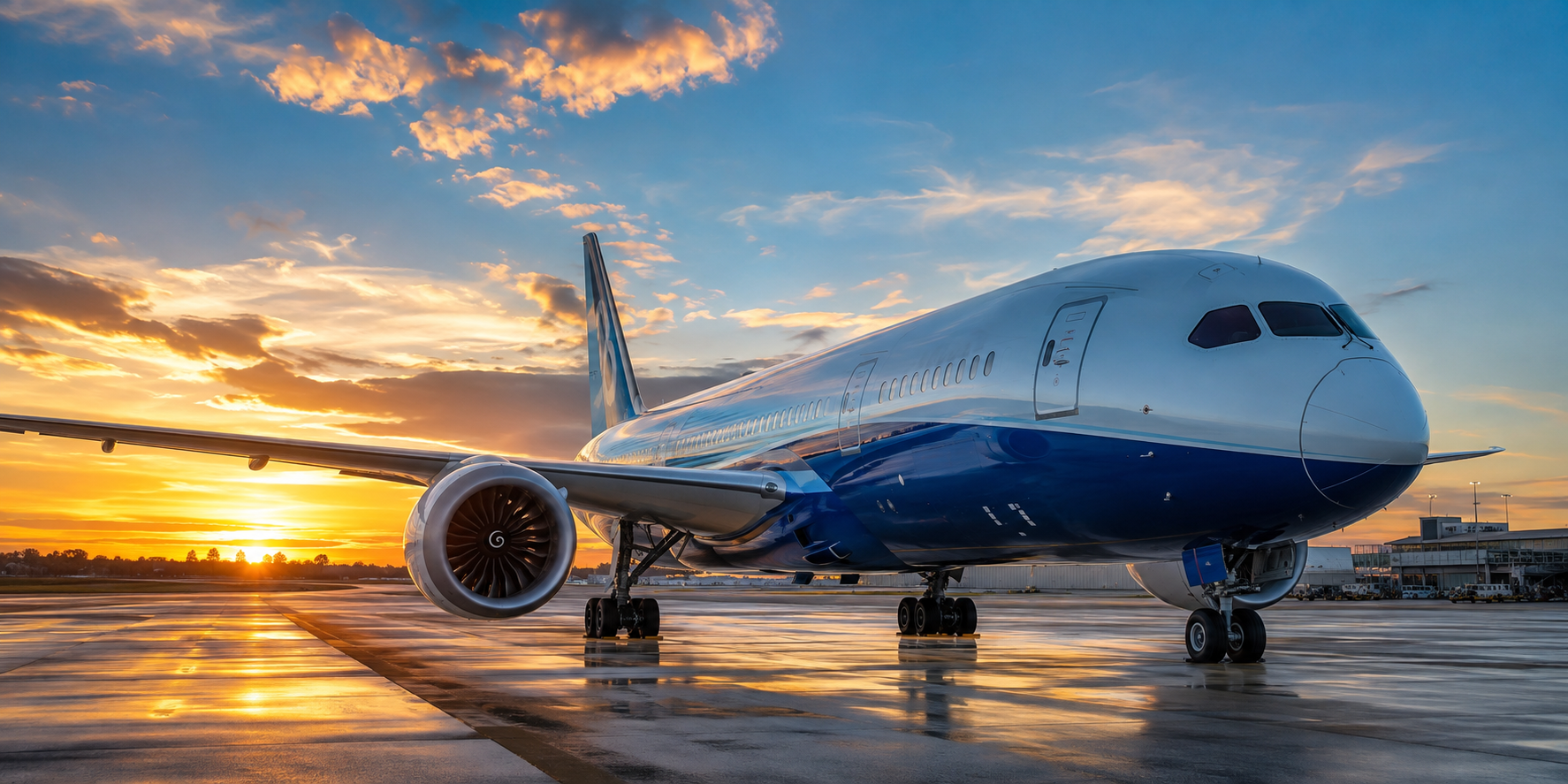
Fifteen years after the Boeing 787 Dreamliner received its type certification, the aircraft has become one of the defining widebody jets of the modern aviation era. It has carried more than a billion passengers, helped airlines launch hundreds of nonstop routes and grown into a three-member family serving everything from relatively thin long-haul markets to high-capacity international routes.
Yet the 15th anniversary arrives with an important reminder of the other side of the 787 story. On August 27, 2026, the US Federal Aviation Administration published a new airworthiness directive requiring inspections on certain Boeing 787-8, 787-9 and 787-10 aircraft because of a manufacturing issue that could contribute to fatigue cracking in parts of the primary wing structure.
The timing makes the anniversary particularly interesting. The 787 has undoubtedly transformed Boeing’s widebody portfolio, but its history also illustrates how difficult it can be to introduce new materials, production techniques and complex global supply chains into commercial aviation.
The Boeing 787’s Defining Moment Came in 2011
The original 787 programme was conceived around a different approach to the traditional widebody aircraft. Boeing made extensive use of composite materials and designed the aircraft around efficiency, long-range capability and a lower operating cost than older-generation aircraft.
Getting there, however, was anything but straightforward.
The 787 programme experienced significant delays during development, with supplier problems, production issues and other challenges repeatedly pushing back the aircraft’s introduction. Boeing’s own historical records show that the first delivery schedule had already slipped before certification was achieved.
That made August 26, 2011, particularly significant.
On that day, the Boeing 787-8 received FAA type certification, clearing the way for the aircraft to enter commercial service. Boeing says the FAA certification formally verified that the aircraft had been tested and found compliant with applicable federal regulations.
For Boeing, it was more than another aircraft certification. The 787 represented a major technological step for the company’s commercial aircraft business.
For airlines, meanwhile, it promised something equally important: the ability to operate long-distance routes with a smaller widebody aircraft and better economics than many older jets.
ANA Put the Dreamliner Into Commercial Service
The next milestone came only a month later.
All Nippon Airways, the 787 launch customer, accepted its first Dreamliner on September 26, 2011. On October 26, the aircraft entered passenger service, operating between Tokyo Narita and Hong Kong.
The arrival of the 787 marked a significant change in the way airlines could approach international network planning.
Instead of requiring a very large aircraft to make long-haul routes viable, airlines could use the 787’s combination of range and capacity to connect cities with comparatively smaller passenger markets. That helped create a business case for routes that might not have supported larger aircraft.
This became one of the Dreamliner’s most important advantages.
According to Boeing, the 787 has helped airlines introduce more than 540 new nonstop routes that had not previously been served. The manufacturer also says the fleet has carried more than one billion passengers.
That is arguably the clearest measure of the aircraft’s influence.
The 787 was not simply designed to replace an older aircraft. It changed the economics of certain routes.
The Dreamliner Family Expanded Beyond the 787-8
The original 787-8 was only the beginning.
Boeing subsequently developed the 787-9, giving airlines a larger aircraft with additional passenger capacity while retaining the basic characteristics of the Dreamliner family. The 787-9 has since become arguably the most versatile member of the family, particularly for long-haul international operations.
Airlines have used the aircraft on some of the world’s longest commercial routes. Qantas, for example, selected the 787-9 for its nonstop Perth-London service, demonstrating the type’s ability to combine range with a relatively moderate passenger capacity.
The final member of the family, the 787-10, took the concept in a different direction.
Rather than simply pushing range further, Boeing increased the aircraft’s capacity. That made the 787-10 attractive for airlines looking to carry more passengers while retaining the efficiency advantages of a newer-generation widebody.
That distinction matters in today’s airport environment.
At slot-constrained airports, airlines cannot always add more frequencies. Increasing the number of seats available on existing flights can therefore become a more practical way of expanding capacity. A 787-10 can provide that additional capacity without requiring an airline to move to a substantially larger aircraft category.
The three variants have consequently allowed Boeing to cover a broad section of the widebody market.
The 787’s Early Years Were Not Easy
The Dreamliner’s success should not obscure how turbulent its introduction was.
After the aircraft entered service, Boeing continued to face production challenges. Deliveries were affected by manufacturing difficulties, while the company also had to deal with one of the most serious incidents in the aircraft’s early history: problems involving its lithium-ion battery system.
In January 2013, the global 787 fleet was temporarily grounded following battery incidents. The FAA subsequently worked with Boeing on a redesigned battery system and extensive testing before the aircraft was allowed to return to service.
The episode demonstrated something important about the 787.
The aircraft introduced technologies that were intended to deliver major benefits, but those innovations also brought new engineering and certification challenges. The FAA later conducted a broader review of the 787’s design, certification and manufacturing systems, emphasizing that the aircraft was an innovative type requiring close attention to its new systems and production methods.
The Dreamliner eventually moved beyond those early problems and established itself as a major commercial success.
But manufacturing quality would continue to be an issue.
A New FAA Order Puts Manufacturing Quality Back in Focus
That brings the story to August 2026.
The FAA’s latest action concerns a limited number of 787s rather than the entire global fleet. The agency’s Airworthiness Directive 2026-17-02 applies to specific 787-8, 787-9 and 787-10 aircraft identified in Boeing’s service documentation. The directive becomes effective on October 1, 2026.
The FAA estimates that 17 aircraft on the US registry are affected, while the global population identified for the inspections is 77 aircraft. That is a relatively small proportion of a 787 fleet numbering more than 1,100 aircraft.
Importantly, this is not a grounding order.
The issue involves manufacturing errors and excessive preload forces around lower side-of-body splice plates associated with the lower outboard wing skins. According to the FAA, shim gaps may have exceeded engineering allowances, while excessive pull-up forces could create conditions in which fatigue cracks form around fastener holes.
That distinction is crucial.
The FAA is not saying that every 787 is at risk of an imminent structural failure. Instead, regulators are requiring operators to inspect specific aircraft so that any potential fatigue damage can be identified before it reaches a critical level.
Why Shims Matter to the 787 Wing
The technical issue may sound obscure, but it is important.
Aircraft structures are manufactured to extremely tight tolerances. When two structural components meet, a small gap can exist, and a shim may be used to achieve the required fit before the components are fastened together.
The problem arises when the gap or the force used to bring the components together falls outside the intended engineering parameters.
In the case covered by the new FAA directive, the concern is that excessive pull-up forces could introduce additional stress around fastener holes. Over thousands of flight cycles, those stresses can contribute to fatigue cracking.
The FAA therefore requires more than a simple visual inspection.
Depending on the aircraft configuration, operators must perform ultrasonic inspections of specified structural areas, including splice plates, rear spar terminal fittings, lower chords, front spar terminal fittings and jack pads. Certain splice plates also require detailed inspections.
Ultrasonic testing is particularly useful because structural damage does not necessarily have to be visible on the outside of a component.
If cracks are discovered, operators must follow approved corrective actions, which can include repairs.
The Issue Goes Back to 2019
Perhaps the most striking element of the latest directive is how long the issue has been in the pipeline.
The FAA says the action was prompted by a Boeing investigation into manufacturing errors and excessive preload forces. Boeing’s investigation dates back to 2019, when the company identified problems involving the method used to measure shims.
The production issue itself has since been corrected, according to Boeing. The current regulatory action is therefore the next stage in addressing aircraft that were already built under the affected manufacturing conditions.
That distinction is worth emphasizing because it changes the interpretation of the FAA action.
This is not evidence that a new manufacturing defect is currently being introduced into every 787 rolling off the production line. Instead, it demonstrates how an issue discovered years earlier can eventually result in mandatory inspections as regulators and manufacturers establish the appropriate long-term structural safeguards.
The Inspections Will Not Be Cheap
For operators, the directive also creates a significant maintenance burden.
The FAA estimates that the required ultrasonic and detailed inspections could take up to 286 labor hours per inspection cycle, translating into a maximum estimated cost of $24,310 per aircraft per cycle. For the 17 US-registered aircraft covered by the directive, the agency estimates a combined cost of up to $413,270 per inspection cycle.
Those figures do not include potential repair costs if cracks are discovered.
The FAA also rejected a request from American Airlines to simplify the inspection schedule. American argued that its internal tracking system could not easily accommodate the equation-based compliance calculations involving flight hours and cycles.
The FAA concluded that both flight hours and cycles were important because the affected structural components are sensitive to flight length.
For airlines, that means another layer of maintenance planning around an aircraft that was originally marketed partly on its efficiency and operational flexibility.
Another Chapter in the 787 Manufacturing Story
The latest wing inspection order is also significant because it is not an isolated example of regulatory scrutiny surrounding Dreamliner production.
The 787 has faced other manufacturing-related issues involving structural gaps and assembly processes. Boeing previously dealt with production interruptions as non-conformities were identified and investigated.
The FAA has also issued directives involving other areas of the aircraft. In one previous case, regulators addressed manufacturing non-conformities involving the forward pressure bulkhead and concerns about excessive gaps and pull-up during assembly.
The similarity between these cases is notable: both involve the consequences of components not fitting together within specified tolerances and the possibility that additional stress could affect structural durability.
That does not erase the 787’s safety record or its commercial achievements. It does, however, show why modern aircraft manufacturing requires continuous inspection and regulatory oversight long after an aircraft has received its type certificate.
What the 15-Year Milestone Really Says About the 787
Fifteen years after certification, the Boeing 787 is still evolving.
Boeing has expanded its production footprint and is investing in the programme to support higher production rates. The company has also secured approval for increased maximum takeoff weights for the 787-9 and 787-10, giving those aircraft additional payload or range capability.
That is a strong indication that the Dreamliner remains central to Boeing’s commercial strategy.
The aircraft has survived its troubled introduction, battery crisis, manufacturing disruptions and years of scrutiny to become a core component of airline fleets around the world.
But the latest FAA action offers a useful qualification to the anniversary celebrations.
The Boeing 787 Dreamliner may have transformed long-haul flying, but its 15-year history also demonstrates that innovation does not end when an aircraft receives certification. Structural performance, manufacturing tolerances, inspection regimes and production quality must continue to be monitored throughout an aircraft’s operational life.
That is ultimately what makes the latest FAA order less a verdict on the entire Dreamliner programme and more a reminder of how modern aviation manages risk.
The 787’s first 15 years have been a mixture of technological ambition, commercial success and manufacturing lessons. Its next 15 may be just as important—not because the aircraft is still proving itself, but because Boeing must continue demonstrating that the production discipline behind one of its most successful widebody families can match the aircraft’s reputation in the skies.
For more on Boeing 787, see: Southwest’s Boeing 787 Plans Could Reshape Its Global Future



Leave a Reply