
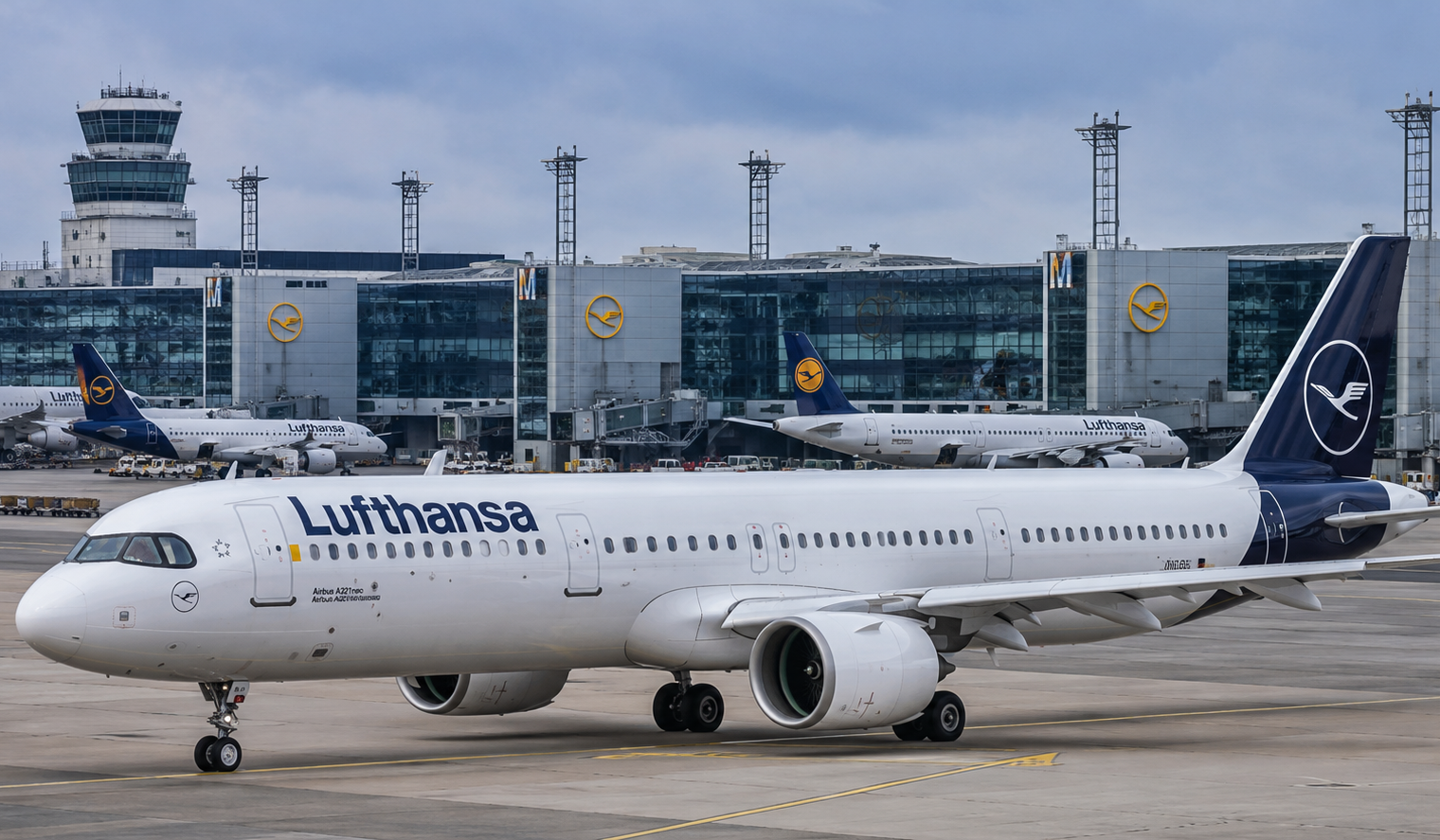
As Europe’s airline industry continues to evolve in response to shifting demand patterns and cost pressures, Lufthansa is undertaking one of its most significant network adjustments in recent years. Germany’s flag carrier has eliminated 23 international routes from its two largest hubs—Frankfurt Airport and Munich Airport—marking a strategic shift aimed at improving efficiency, optimizing capacity, and strengthening long-term profitability.
The route reductions span destinations across Europe and North America and form part of a broader restructuring initiative within the Lufthansa Group. While some services have been transferred to affiliated airlines such as Discover Airlines, Air Dolomiti, Austrian Airlines, and Lufthansa City, others have disappeared from the network altogether.
The move underscores Lufthansa’s changing approach to network planning as the airline seeks to concentrate resources on routes with stronger commercial performance while leveraging lower-cost operators within its group structure.
Frankfurt Sees Significant Route Rationalization
Frankfurt Airport, Lufthansa’s primary global hub, has experienced the largest share of the reductions. The airline has removed 11 international destinations from its schedule, affecting both regional European markets and transatlantic operations.
The routes no longer operated directly by Lufthansa from Frankfurt include Bordeaux, Bydgoszcz, Glasgow, Katowice, Larnaca, Minneapolis, Newcastle, Rzeszów, Stavanger, Skopje, and Toulouse.
Several of these routes had historically been served by Lufthansa CityLine, the regional subsidiary that played a key role in feeding passengers into the carrier’s long-haul network. Following the gradual wind-down of CityLine operations, Lufthansa has reassessed the viability of maintaining a number of these services under its mainline structure.
Not every route has disappeared entirely. Lufthansa Group carriers have stepped in to preserve connectivity in select markets where demand remains attractive.
One of the most notable examples is Minneapolis, a destination that continues to be served through Discover Airlines, Lufthansa Group’s leisure-focused subsidiary. The transition allows the group to maintain access to the U.S. market while operating under a cost structure better suited to leisure-oriented travel demand.
Similarly, flights between Frankfurt and Larnaca have been reassigned to Discover Airlines, ensuring continued service while freeing Lufthansa to deploy aircraft and crews elsewhere within its network.
However, some destinations have not been retained within the group’s route structure. Cities such as Glasgow, Newcastle, and Skopje are among those that no longer appear in Lufthansa’s direct network offerings from Frankfurt. Although passengers may still reach these destinations through partner airlines or connecting services, Lufthansa’s own nonstop operations on these routes have ended.
Munich Network Also Undergoes Major Changes
Munich Airport, Lufthansa’s second-largest hub and a cornerstone of its European operations, has also experienced extensive route restructuring.
The airline has withdrawn service from 12 international destinations: Ancona, Asturias, Billund, Gdańsk, Larnaca, Oulu, Poznań, Rzeszów, Sibiu, Tallinn, Timișoara, and Vienna.
As with Frankfurt, several of these routes have been absorbed by other airlines within the Lufthansa Group rather than being abandoned entirely.
Italian regional carrier Air Dolomiti has become the sole operator on the Munich–Ancona route, reflecting the group’s strategy of assigning thinner regional markets to specialized operators. Meanwhile, flights between Munich and Timișoara have transitioned to Lufthansa City, which is gradually assuming responsibilities previously handled by Lufthansa CityLine.
The important Munich–Vienna corridor has also seen a shift in operating responsibility. Austrian Airlines, another Lufthansa Group carrier, now exclusively serves the route, streamlining operations between the two major Central European hubs.
Nevertheless, a number of destinations have disappeared from the Munich network altogether. Routes to Oulu, Sibiu, Larnaca, and Rzeszów have been removed without replacement, highlighting the airline’s willingness to exit markets that no longer fit its strategic priorities.
Lufthansa Group’s Multi-Airline Strategy Takes Center Stage
The latest route cuts are part of a broader transformation taking place across the Lufthansa Group. Rather than relying solely on Lufthansa mainline operations, the company is increasingly utilizing a portfolio of specialized airlines to serve different market segments.
This approach allows the group to match operating costs more closely with route economics. Leisure destinations can be served by Discover Airlines, regional markets can be handled by Lufthansa City or Air Dolomiti, and premium business-focused routes can remain within Lufthansa’s core network.
The restructuring also reflects industry-wide pressures facing European carriers. Rising labor costs, aircraft delivery delays, environmental regulations, and ongoing operational challenges have forced airlines to scrutinize route performance more closely than ever before.
By consolidating operations and reducing overlap between group carriers, Lufthansa aims to create a more flexible network capable of adapting to changing market conditions.
Poland Among the Hardest-Hit Markets
One of the most noticeable outcomes of Lufthansa’s schedule changes is the reduction of service to Poland.
Several Polish destinations have been affected by the restructuring, including the discontinuation of routes from Munich to Poznań and Gdańsk. Additional frequency reductions across the country suggest Lufthansa is reassessing demand patterns and competitive dynamics within the Polish market.
The changes come at a time when competition from low-cost airlines continues to intensify throughout Central and Eastern Europe. Carriers such as Ryanair and Wizz Air have expanded aggressively in the region, often making it difficult for traditional network airlines to sustain smaller point-to-point routes profitably.
As a result, Lufthansa appears to be concentrating its resources on higher-demand connections while relying on its broader alliance and group network to maintain regional connectivity.
Focus on Profitability and Long-Term Growth
Despite eliminating 23 international routes, Lufthansa remains one of Europe’s most influential network carriers and continues to operate an extensive global route system.
The latest adjustments should not be viewed solely as a reduction in service but rather as a recalibration of how the airline deploys capacity. By shifting certain routes to subsidiary carriers, exiting underperforming markets, and concentrating resources on stronger demand centers, Lufthansa is positioning itself for more sustainable growth.
The strategy reflects a broader trend among legacy airlines worldwide, where profitability and operational efficiency increasingly outweigh network size as measures of success.
As Lufthansa continues integrating new operating models and refining its route portfolio, further network adjustments are likely. For passengers, this may mean flying on a different Lufthansa Group airline than before, but for the company, the changes represent a deliberate effort to build a more resilient and competitive business in an increasingly challenging aviation landscape.
For more on Lufthansa, see: Lufthansa Expands ITA Stake in $382 Million Deal





Leave a Reply