
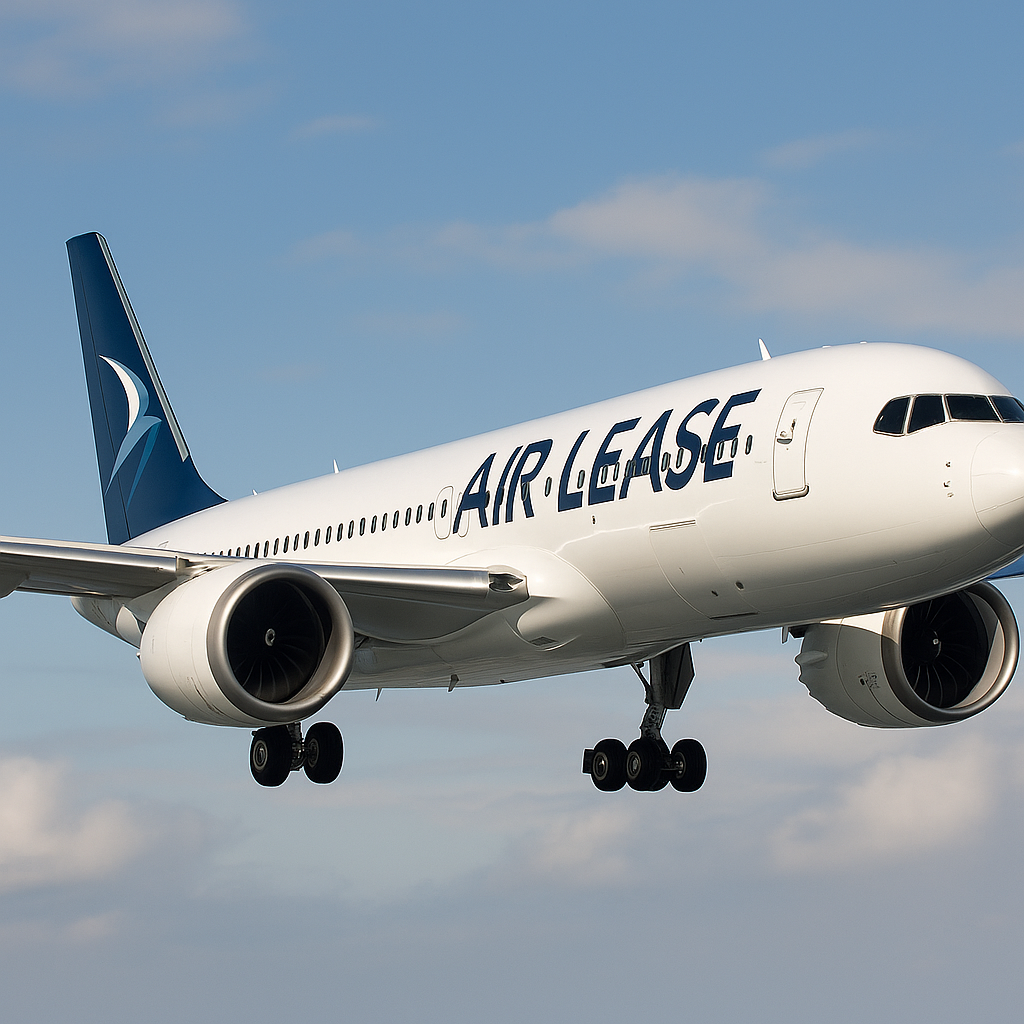
Fleet Expansion and Transaction Highlights Air Lease Corporation (ALC) remains focused on measured growth as global production constraints continue to limit supply of new aircraft. As of September 30 2025, ALC owned 503 aircraft and managed 50, with an orderbook of 228 jets scheduled for delivery through 2031. Its fleet has an average age of 4.8 years and an average remaining lease term of 7.2 years, according to mid-year investor materials. During the quarter the company invested $685 million, taking delivery of 13 new aircraft — including two Airbus A220s, two A321neos, six Boeing 737-8s and three 737-9s. It sold five aircraft for about $220 million, continuing its capital recycling approach of selling mature assets to fund next-generation deliveries. A $60 million insurance gain was also recognized during the quarter, reflecting continued recoveries from aircraft formerly leased to Russian operators. Cumulative recoveries since 2022 now exceed $823 million of the original $791 million exposure.

Q3 2025 vs Q3 2024: Steady Activity in a Tight Market Air Lease’s Q3 2025 activity mirrors its Q3 2024 pace but with lower volume as OEM delays persist. In Q3 2024 the company took 20 deliveries and invested ~$1.9 billion; in 2025 that fell to 13 deliveries and $685 million. Aircraft sales decreased from nine to five units year-over-year. Revenue momentum remains solid: Q3 2024 lease revenue was $625 million, up 3.5 percent year-on-year at that time; for 2025 the company has not yet reported its earnings but guidance suggests continued high-single-digit growth. ALC maintains a debt-to-equity ratio of 2.63× and investment-grade ratings (BBB / Baa1).
Financials Snapshot
| USD millions | 2022 | 2023 | 2024 | YoY Δ ’24 vs ’23 |
|---|---|---|---|---|
| Lease Revenue | 2,215 | 2,478 | 2,488 | +0.4 % |
| Total Revenues | 2,317 | 2,685 | 2,734 | +1.8 % |
| Net Income | -139 | 573 | 372 | -35.1 % |
| Operating Cash Flow | 1,382 | 1,747 | 1,677 | -4.0 % |
| Total Assets | 28,406 | 30,452 | 32,278 | +6.0 % |
| Total Debt | 18,200 | 19,183 | 20,210 | +5.4 % |
| EPS (Diluted, US$) | -1.24 | 5.14 | 3.33 | -35.2 % |
| Debt-to-Equity | 2.5× | 2.68× | 2.68× | — |
Net income fell in 2024 due to higher interest expense and lower gains on aircraft sales compared with 2023, when insurance recoveries boosted earnings. Nonetheless, total assets grew 6 percent to $32.3 billion, and cash generation remained strong. Management emphasized that operating cash flow of $1.68 billion comfortably covered capital spending and dividends.

Fleet and Orderbook Context
| Type Family | Approx. Units (Owned + Managed) | % of Fleet |
|---|---|---|
| Airbus A320/A321 (neo + ceo) | ≈170 | 31 % |
| Boeing 737 (MAX + NG) | ≈159 | 29 % |
| Airbus A330/A350 | ≈71 | 13 % |
| Boeing 787 | ≈42 | 8 % |
| Airbus A220 | ≈40 | 7 % |
| Other regional and mid-life types | ≈70 | 12 % |
Totals adjust from Q2 2025 disclosures plus Q3 deliveries and sales. ALC’s focus remains on new-technology narrowbodies (A321neo and 737 MAX-8/9), which now represent nearly 60 percent of its portfolio value. Its 228-aircraft orderbook includes A321neo, A220-300, and 787-9 models scheduled for delivery through 2031. These will gradually replace older A320ceo and 737-800 aircraft and support fleet growth in the 6–8 percent range annually once supply-chain bottlenecks ease.
Comparing 2025 to 2024 Activity
| Metric | Q3 2024 | Q3 2025 | Change |
|---|---|---|---|
| Deliveries | 20 | 13 | -35 % |
| Investments | $1.9 B | $685 M | -64 % |
| Aircraft Sales | 9 | 5 | -44 % |
| Sale Proceeds | $340 M | $220 M | -35 % |
| Owned Fleet | 485 | 503 | +4 % |
| Managed Fleet | 64 | 50 | -22 % |
| Orderbook | 287 | 228 | -21 % (deliveries progressed) |
The data underscores ALC’s emphasis on steady throughput rather than fleet size expansion. Its capital deployment pattern shows the company re-investing disposal proceeds into next-generation narrowbodies while maintaining a stable balance sheet.
Funding and Liquidity At mid-2025, ALC reported $7.9 billion in liquidity, including cash, undrawn revolvers and committed financing. Its average debt maturity was 5.2 years, and 76.7 percent of debt was fixed-rate. The company has continued to issue modest tranches of unsecured notes to extend tenor while maintaining a mix of secured and unsecured funding to optimize cost. This approach contrasts with Avolon’s more aggressive shift toward unsecured capital markets. Air Lease retains balance sheet flexibility for selective aircraft purchases and maintains one of the lowest leverage profiles among large lessors.
Insurance Settlements and Russia Exposure The third-quarter insurance gain of $60 million is part of Air Lease’s multi-year effort to resolve Russian exposures from 2022. To date, the company has recovered over $823 million of $791 million in booked losses through settlements with minimal claims outstanding. The progress removes a lingering balance-sheet overhang and could yield further recoveries in 2026.
Market and Outlook The aircraft leasing sector continues to benefit from tight supply and robust demand. OEM production bottlenecks have stretched lead times to the end of the decade, supporting lease-rate factors and residual values. Air Lease estimates that average lease yields have risen 30–40 basis points since 2023, with renewal rates remaining firm. With 96 percent of lease revenue already contracted for 2026 and a weighted average lease term of 7.2 years, the company enters the next cycle on solid footing. Roughly 45 deliveries are scheduled for 2026, primarily A321neo and 787-9 models, which will further modernize the portfolio.
Avolon vs Air Lease: Different Playbooks, Shared Momentum
| Metric (Q3 2025) | Avolon | Air Lease |
|---|---|---|
| Total Fleet | 1,159 | 553 |
| Orderbook | 522 | 228 |
| Quarter Funding / Investment | $2.2 B (unsecured funding) | $685 M (investments) |
| Aircraft Sold | 15 | 5 |
| Placement Coverage | 99 % (next 24 mo) | 98 % (through 2026) |
Both lessors are benefiting from strong airline demand and limited OEM output, but their capital approaches diverge: Avolon leverages scale and financing breadth; Air Lease leans on its low-age fleet and conservative funding discipline.
Conclusion: Strength in Consistency Air Lease enters the final quarter of 2025 with a young fleet, ample liquidity and a long runway of contracted revenue. Its $685 million in quarterly investments, $220 million in sales and $60 million insurance gain underscore both financial resilience and capital discipline. While Avolon has made headlines with its mega-order and fund-raising drive, Air Lease continues to excel at what it does best: steady execution, transparent governance and measured growth through cycles. That strategy has kept the company profitable across two decades and well-positioned to capture the next wave of global fleet renewal.
For other leasing company financial analysis coverage, see our story on Avolon.



Leave a Reply