
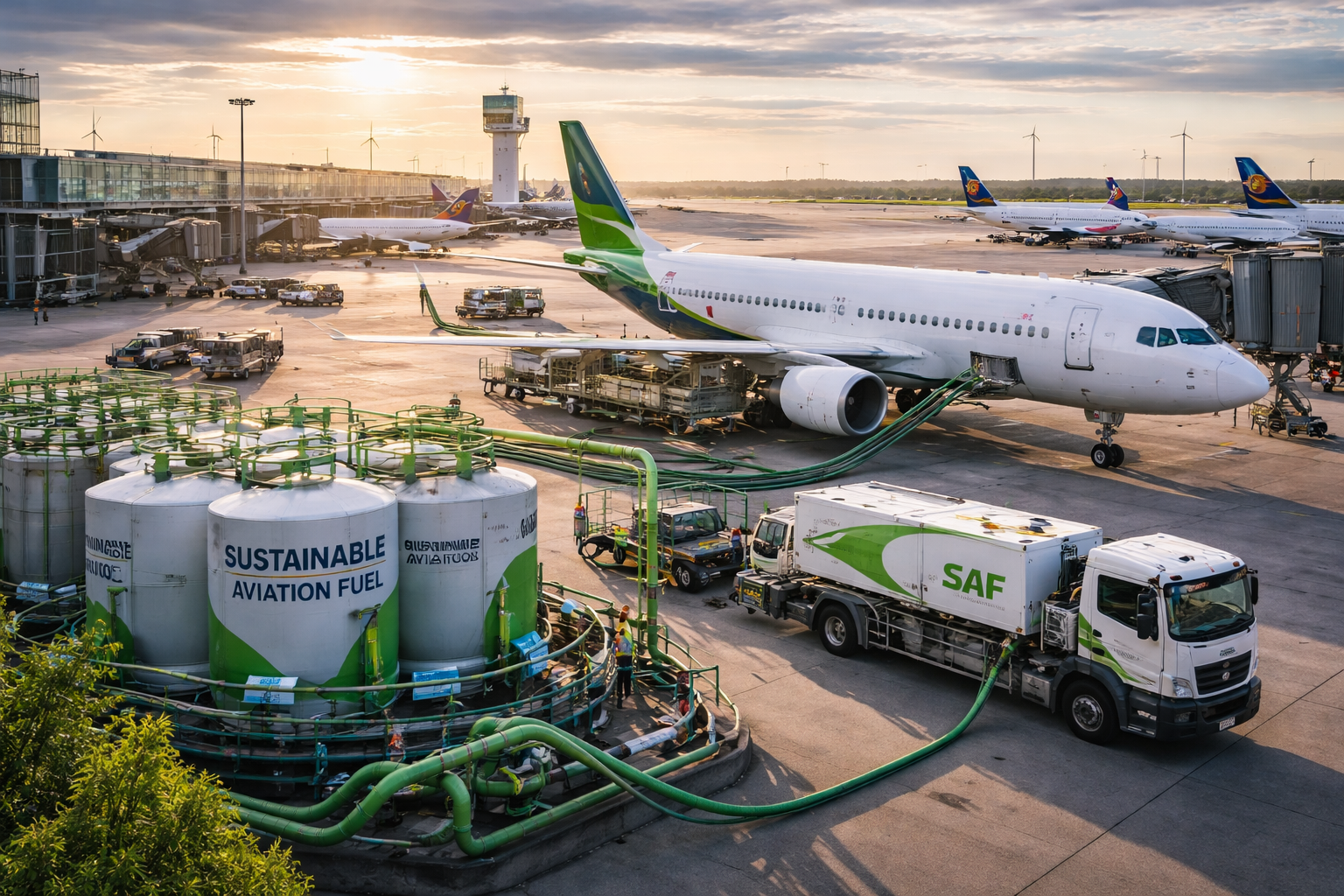
Europe’s aviation industry has quietly delivered one of its strongest climate signals in years. Early indications suggest the sector not only met but likely exceeded the European Union’s 2% sustainable aviation fuel (SAF) mandate for 2025—a target many carriers once warned would be missed.
The development marks a sharp turnaround from 2024, when SAF usage stood at just 0.6%, exposing a wide gap between ambition and execution. Twelve months on, that gap appears to have narrowed significantly, driven by regulatory pressure, improving supply dynamics, and a reluctant but decisive shift by airlines.
According to European Union Aviation Safety Agency chief Florian Guillermet, early estimates point to compliance at—or slightly above—the mandated threshold. Formal data is expected later this year, but multiple officials suggest the outcome is no longer in doubt.
From Missed Expectations to Measurable Progress
The scale of the rebound is difficult to overstate. Moving from 0.6% to over 2% SAF penetration in a single year represents a more than threefold increase in adoption—an acceleration few industry observers had forecast.
At the heart of this shift is the EU’s binding requirement that 2% of aviation fuel supplied at regional airports be sustainable by 2025. Unlike voluntary schemes, this mandate created a non-negotiable compliance framework, forcing movement across the supply chain.
A senior official within the European Commission noted that fuel producers responded faster than expected once demand became guaranteed. The result has been a measurable uptick in SAF availability, even as structural constraints remain.
For airlines, the transition has been less about enthusiasm and more about necessity. Many carriers had argued that SAF volumes were insufficient and costs prohibitive. Both concerns remain valid—but neither proved enough to derail compliance.
Airlines Absorb Costs, Adjust Strategies
Europe’s largest airline groups, represented by Airlines for Europe, have played a central role in reaching the 2025 target. Members such as Ryanair, Lufthansa, and International Airlines Group have steadily increased SAF procurement despite the financial burden.
The economics remain challenging. SAF can cost anywhere from two to five times more than conventional jet fuel, depending on production methods and feedstock availability. That premium has forced airlines to rethink cost structures and, in some cases, quietly pass on increases to passengers.
To manage the transition, carriers have leaned on a mix of operational and financial levers:
- Long-term purchase agreements with SAF producers
- Joint ventures with energy companies
- Gradual blending at major hub airports
- Sustainability-linked financing instruments
Even so, industry executives continue to stress that current pricing levels are not sustainable in the long term without policy support or technological breakthroughs.
Synthetic Fuels Stir Industry Tension
If the 2% milestone reflects progress, the road ahead is far more contested—particularly when it comes to synthetic aviation fuels, or eSAF.
Unlike conventional SAF derived from biological feedstocks, eSAF is produced using renewable electricity and captured carbon. While it offers greater long-term scalability and emissions reduction potential, it is significantly more expensive and remains limited in supply.
Under EU rules, SAF must reach 6% of total aviation fuel by 2030. Within that, at least 1.2% must come from eSAF, rising to 5% by 2035.
Airlines, through A4E, have pushed back on these sub-targets, arguing they are out of sync with market realities. Production capacity for eSAF is still in its infancy, and costs remain well above even bio-based SAF.
Yet policymakers have shown little willingness to compromise. Officials within the European Commission have made clear that the mandates will stand, viewing them as essential to unlocking investment in next-generation fuel technologies.
Guillermet has echoed that stance, suggesting that early success in meeting the 2025 target strengthens the case for maintaining regulatory pressure.
Energy Security Adds Urgency
Beyond climate goals, SAF is increasingly being framed as a tool for energy security. Recent disruptions linked to the Iran conflict oil disruptions have underscored the vulnerability of global fuel markets.
For Europe, reducing reliance on imported fossil fuels has become a strategic priority. SAF—particularly when produced domestically—offers a pathway to diversify supply and insulate the aviation sector from geopolitical shocks.
This broader context has reinforced political commitment to the SAF agenda, even as airlines continue to raise concerns about cost and competitiveness.
Supply Chain Response Gains Momentum
One of the more telling aspects of Europe’s 2025 performance is how quickly the supply side has adapted. Fuel producers, initially cautious about committing capital, have begun scaling operations as demand signals firm up.
Across the region, investment in SAF production capacity has accelerated, with new facilities coming online and existing plants expanding output. Energy companies, once peripheral players in aviation fuel, are now positioning themselves at the center of the transition.
At the same time, technological pathways are diversifying. While bio-based SAF remains dominant, momentum is building behind power-to-liquid (PtL) processes that could underpin future eSAF production.
Still, constraints persist. Feedstock availability remains a limiting factor for biofuels, while eSAF faces high energy requirements and infrastructure gaps. Bridging these challenges will be critical to meeting the next wave of targets.
Cost Pressures Begin to Surface
As SAF adoption rises, its cost impact is becoming harder to ignore. Airlines are already operating in a high-cost environment, with fuel representing one of their largest expenses. Introducing a more expensive alternative inevitably reshapes the economics.
Some carriers have begun adjusting fares or introducing sustainability surcharges, while others are focusing on efficiency gains—modernizing fleets, optimizing routes, and reducing overall fuel burn.
For passengers, the shift may translate into gradually higher ticket prices, particularly on routes where SAF blending is more prevalent.
At a broader level, the transition raises questions about market dynamics. Will European carriers face a competitive disadvantage compared to regions with less stringent mandates? Or will early adoption position them as leaders in a decarbonizing global industry?
Policy Certainty Drives Market Behavior
If there is a single takeaway from Europe’s SAF progress, it is the power of policy certainty. By setting clear, binding targets, the EU has effectively forced alignment across airlines, fuel suppliers, and investors.
This contrasts with more fragmented approaches elsewhere, where SAF adoption has lagged due to weaker incentives and less predictable demand.
European officials argue that consistency—not flexibility—is what ultimately drives transformation. The early success of the 2025 mandate appears to support that view, demonstrating that industry can adapt when expectations are unambiguous.
A Milestone, Not a Finish Line
Despite the positive momentum, SAF still represents a small fraction of total aviation fuel use. The industry remains overwhelmingly dependent on fossil fuels, and scaling alternatives will require sustained effort over decades.
Key hurdles remain firmly in place:
- Expanding SAF production capacity at pace
- Narrowing the cost gap with conventional jet fuel
- Commercializing eSAF at scale
- Aligning global regulatory frameworks
Yet the progress made in 2025 offers a tangible proof point. It shows that even in a sector as complex as aviation, coordinated policy and market response can deliver measurable change.
Looking Ahead to 2030
The next milestone—6% SAF by 2030—will be significantly more demanding. Achieving it will require not just incremental gains but a step-change in production, investment, and technological innovation.
Airlines, fuel producers, and policymakers will need to work in closer alignment than ever, balancing environmental ambition with economic reality.
For now, though, Europe’s ability to meet—and likely exceed—the 2% target sends a clear signal: the transition to lower-emission aviation is underway, and it may be moving faster than many expected.
For more on similar developments, see: Singapore Delays SAF Levy Amid Airline Cost Pressures


Leave a Reply