
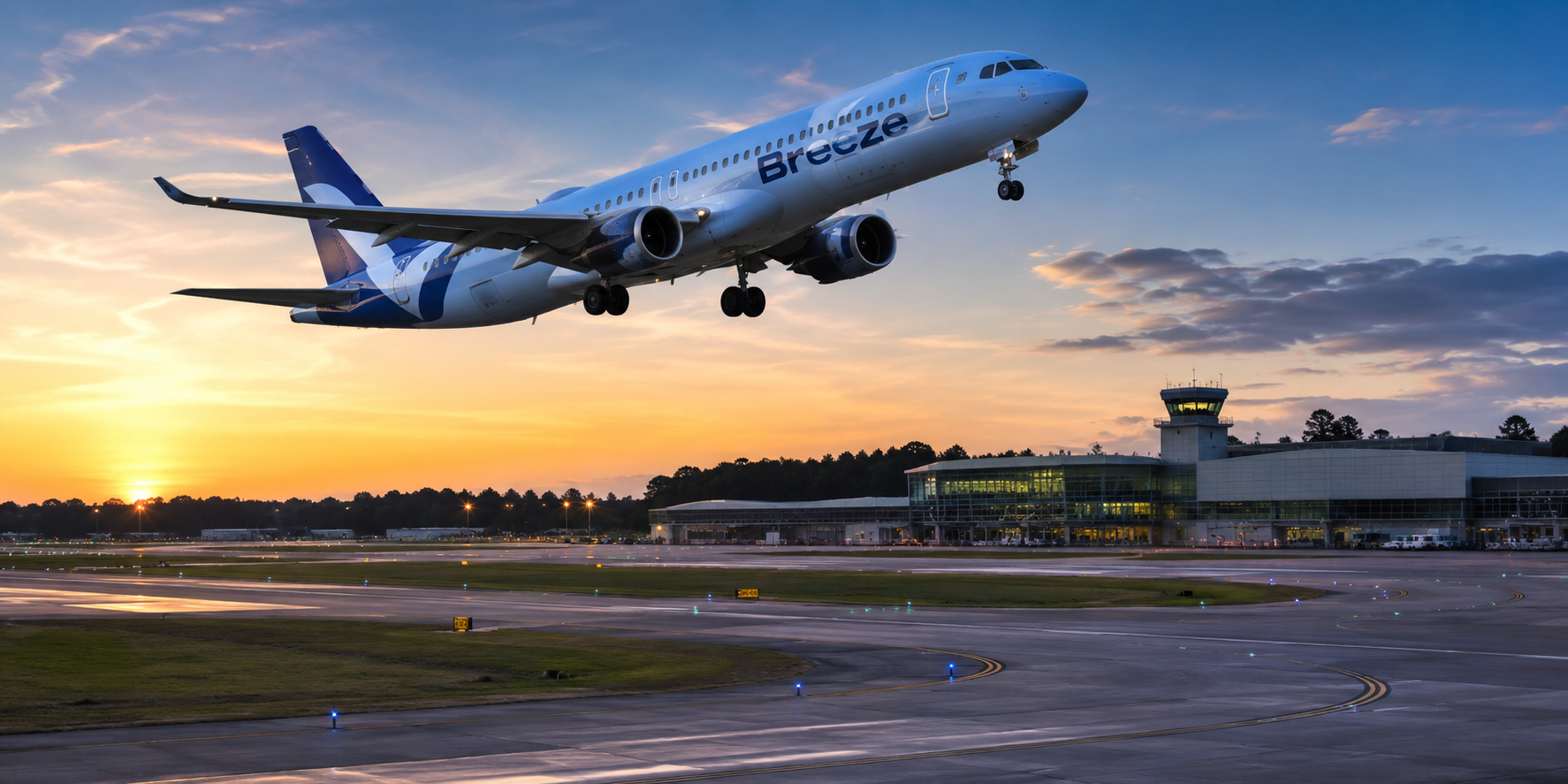
Breeze Airways is growing quickly, but its expansion is not reaching every airport equally.
The airline is set to make a significant reduction at Daytona Beach International Airport (DAB) this September, with scheduled departures falling to just 17. That is down from 41 departures in September 2025, a decline of almost 60%.
At first glance, the numbers suggest Breeze Airways is pulling back from Daytona Beach. The bigger picture, however, is more interesting.
Breeze is actually adding a substantial amount of capacity across its wider network. The airline is scheduled to operate 6,823 flights in September 2026, compared with 4,755 during the same month last year. That is an increase of more than 2,000 flights.
So why is Daytona getting fewer flights while Breeze is expanding elsewhere?
The answer appears to come down to a mix of seasonal demand, route performance, competition from larger airports and the increasingly important question of where Breeze can get the most from each aircraft.
Breeze’s Daytona network has become much smaller
Breeze arrived at Daytona Beach International Airport in November 2024, initially launching service to Westchester County Airport in New York.
The airline then expanded its presence, adding Hartford, Raleigh-Durham and Providence before introducing Akron-Canton in May 2025. For a time, DAB had five Breeze destinations, giving local travelers access to several markets that were not previously served nonstop by the airline.
That growth now looks considerably different.
For September 2026, only Raleigh-Durham and Providence are scheduled to operate. Akron-Canton is due to return in November, while Hartford is scheduled to resume service on January 7, 2027.
Westchester is the exception. There is currently no future nonstop service to Westchester listed in Breeze’s schedule.
That means the September reduction should not be viewed as five routes suddenly disappearing for good. Two of the cuts are seasonal pauses, while Westchester appears to have been dropped from the network.
Still, the reduction in monthly departures is substantial.
For travelers based around Daytona Beach, fewer Breeze flights mean fewer opportunities to take advantage of the airline’s low-fare model without driving to another airport.
Breeze is putting its aircraft elsewhere
The most revealing part of the story is what Breeze is doing at other airports.
Raleigh-Durham is becoming one of the airline’s biggest bases of growth. Breeze is scheduled to increase departures there from 371 in September 2025 to 587 this September.
Orlando is also gaining 196 departures year over year, while Tampa is adding 228.
Those numbers put the Daytona cuts into perspective.
Breeze is not short of demand for its aircraft. It is reallocating capacity toward markets where it sees greater potential.
Raleigh-Durham, in particular, has become an important part of the airline’s strategy. Breeze has established a crew base there and has continued adding destinations, giving the airport a much larger role in its network than it had when the airline first arrived.
Tampa and Orlando offer another obvious advantage. Both are major Florida markets with large local populations, strong tourism demand and far greater volumes of connecting and originating passengers than Daytona Beach.
That does not necessarily mean every route at a larger airport will perform better. It does mean Breeze has more opportunities to build a sizable operation.
For an airline adding aircraft rapidly, that matters.
Daytona has a demand problem of its own
Daytona Beach International Airport has been performing well by its own standards.
The airport handled more than 770,000 passengers in 2025, an increase of 11% from the previous year. That was its strongest annual passenger performance since 1997.
The challenge is that airport growth does not automatically translate into strong results for every airline or route.
Daytona sits between two much larger aviation markets: Orlando and Jacksonville.
Travelers living in the Daytona area can reach both airports by road, and the larger facilities typically offer substantially more flights and destinations. A passenger may therefore be willing to drive farther if the savings or schedule are attractive enough.
Previous government analysis has estimated that a significant share of passengers in the Daytona catchment area leaks to nearby Orlando and Jacksonville. Fares, flight frequency and available destinations are among the factors influencing that behavior.
That puts DAB in a difficult position.
The airport can attract more passengers overall while individual routes still struggle to generate enough demand to justify additional capacity.
Route performance tells part of the story
Breeze’s route-level performance at Daytona also offers some clues.
Based on the cited Department of Transportation data for June 2025 through May 2026, Breeze’s overall load factor at DAB was around 71%.
But the routes did not perform equally.
Hartford recorded an 83% load factor and Providence reached 77%. Akron-Canton stood at about 71%, while Westchester was closer to 64%.
Raleigh-Durham was lower, at approximately 58%.
Load factor alone does not determine whether a route makes money. Fares, operating costs, aircraft utilization and other factors all matter.
Even so, the figures help explain why Breeze may be treating individual markets differently.
A route with solid demand may be worth keeping in the schedule, particularly if it has strategic value. Another route may not offer the same opportunity when the airline has larger markets competing for the same aircraft.
That could help explain why Providence remains in the September schedule while Westchester has disappeared.
September is not an easy month for Florida demand
There is another factor that should not be overlooked: September.
Florida tourism does not move in a straight line throughout the year. Daytona Beach experiences a softer period toward the end of summer before demand begins to improve later in the year.
Hotel occupancy around the destination typically dips in September, making it a logical period for airlines to trim capacity.
Breeze has done this before.
Rather than maintaining the same schedule throughout the year, the airline frequently adjusts service according to seasonal demand. That allows it to move aircraft into markets where they are likely to be more productive.
The temporary suspension of Fort Myers-to-Albany service is another example.
Breeze is set to pause the Fort Myers (RSW) to Albany (ALB) route throughout September, with the airline pointing to high fuel costs as one factor behind the decision. The route is scheduled to return in October, and tickets are already available for the resumed service.
Elsewhere, Breeze is also reducing the frequency of its Fort Lauderdale-to-Akron/Canton service from two flights per week to one.
These changes suggest the Daytona cuts are part of a broader schedule adjustment rather than an isolated decision.
Fuel costs are adding another layer
The Fort Myers-Albany suspension is particularly useful when looking at Breeze’s September strategy.
Airlines have to be extremely careful with routes that are heavily exposed to operating costs. Fuel prices can quickly change the economics of a flight, particularly on routes where demand is seasonal or inconsistent.
Suspending a route for one month gives an airline some flexibility.
Breeze can remove capacity during a weaker period, avoid some operating costs and then bring the service back when conditions are more favorable.
That appears to be what is happening with Fort Myers-Albany.
The same logic can be applied to some of the Daytona reductions. Akron-Canton and Hartford are not necessarily gone. They are simply not operating during September.
This is an important distinction because it changes the story from “Breeze abandons Daytona” to something more nuanced: Breeze is becoming more selective about when and where it flies.
The airline is still growing aggressively
Perhaps the most striking part of Breeze’s September schedule is the sheer scale of its overall expansion.
The airline is expected to operate 6,823 flights during September 2026, compared with 4,755 a year earlier.
That means Breeze will fly considerably more despite reducing service in several individual markets.
The airline’s expanding Airbus A220 fleet is helping make that possible. But adding aircraft creates another challenge: they have to be deployed where they can produce the best results.
That is where Daytona Beach finds itself competing with much larger opportunities.
Breeze can use an additional aircraft to build up a major station such as Raleigh-Durham, expand its presence in Tampa or Orlando, enter another underserved market, or maintain a relatively small operation at Daytona.
The airline’s current schedule suggests that some of those alternatives are winning.
What this means for Daytona Beach
For Daytona travelers, the immediate impact is straightforward.
There will be fewer Breeze Airways flights during September, and passengers looking for certain destinations may need to consider Orlando, Jacksonville or another airline.
But it would be premature to describe Breeze’s relationship with Daytona as over.
Providence and Raleigh-Durham remain in the schedule. Akron-Canton is expected to return in November, and Hartford is scheduled to come back in January.
The bigger concern is whether Daytona can retain those routes over the longer term while Breeze continues finding new opportunities elsewhere.
That is the real story behind the 60% reduction.
Breeze Airways is not cutting back because the airline has stopped growing. It is cutting selectively while putting much more capacity into markets where it believes the opportunity is stronger.
For Daytona Beach International Airport, that creates a new challenge. Passenger numbers may be rising, but airlines still have to be convinced that DAB is the best place to deploy scarce aircraft.
And with Breeze expanding by thousands of flights a year, Daytona is now competing not just against other airports in Florida, but against virtually every other market the airline serves.
For now, Breeze has not walked away from Daytona.
It has simply made clear that, in a rapidly expanding network, not every airport is going to grow at the same speed.
For more on Breeze Airways, see: Breeze Airways Reshapes US Network After Five Years







Leave a Reply